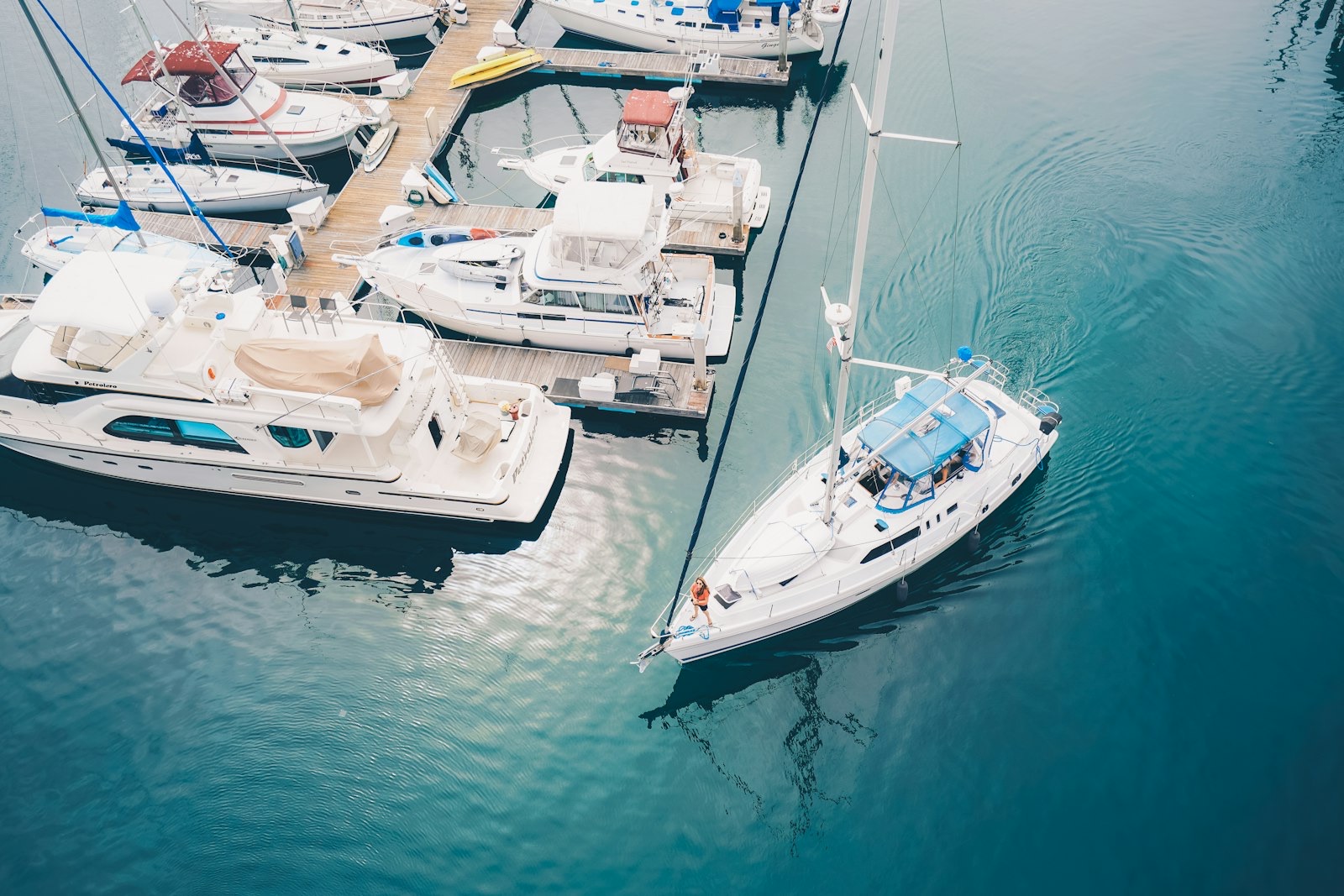
Mooring is the cost that surprises people, because it is not in the charter price and it is not small. On a two-week trip in Croatia it can add more than the flights. It is also the one running cost you control completely, which makes it worth ten minutes of understanding before you leave.
The four ways to spend a night, cheapest first
Anchoring in an open bay is free. You need a plan for wind shifts, enough chain, and the willingness to move at two in the morning if the forecast was wrong. No water, no power, no shore.
A mooring buoy costs something in the region of €20 to €80 a night depending on the place and the boat. Someone usually comes out in a tender to collect. Often there is a restaurant attached and the fee is reduced or waived if you eat there, which is a genuinely good deal and also the point of the arrangement.
A town quay sits in the middle: cheaper than a marina, right in the village, usually with water and power and rarely with showers. Availability is first-come.
A marina berth is the expensive, comfortable option — laid lines, power, water, showers, often a pool, and someone to take your stern line when the crosswind is pushing you sideways.
What marinas actually charge
Price follows length overall, season, and country, in that order. The figures below are the shape of the market rather than a tariff — every marina publishes its own and they move every year.
Greece is the cheaper of the two big charter countries. A 35 to 55 foot boat in Athens at Alimos sits in the region of €30 to €45 a night in either season. Preveza runs from around €30 in low season to €90 in high. Rhodes falls between €45 and €85. Gouvia on Corfu is at the top of the Greek range and can pass €130 for a large boat in August.
Croatia is materially more expensive. ACI Pula for a 35 footer in low season is around €70, rising towards €120 at 55 feet. ACI Split is higher again, from roughly €115 to €190 across the same size range in low season. In peak season a standard twelve-metre boat commonly lands between €50 and €150, and anything materially larger can pass €200.
These are not comparable to a Greek night, and that gap is a real input into choosing between a Croatian week and a Greek one. The boat may cost the same. Fourteen nights alongside will not.
The catamaran surcharge nobody budgets for
A catamaran occupies the width of roughly two monohulls, and marinas charge accordingly — commonly 50 per cent more and sometimes double the monohull rate for the same length.
Over a fortnight of marina nights that is a significant number, and it belongs in the comparison from the start rather than appearing at the first berth. It is the single most common omission when people price a catamaran against a monohull. It also argues for a different rhythm: catamarans draw very little water and anchor comfortably in bays that a deep-keeled sailing boat cannot reach, so the type that pays most for a berth is also the type that needs one least. Crews who use that properly spend less on mooring with a catamaran in Croatia than they would on a monohull.
Buoy fields, park fees and the per-metre trap
Some Croatian buoy fields price by boat length rather than per night, in a band of roughly €5 to €30 per metre. At the top of that range a forty-foot boat can be asked for a sum that looks like a mistake and is not. Some add a reservation fee of around €30 on top.
National parks charge separately again, per boat and sometimes per person, and the fee applies to entering the water rather than to mooring in it. The Kornati and Mljet are the two that catch charter crews. If your route goes through a park, that fee is part of the day whether you tie up or not.
And one piece of local practice worth knowing: pre-booked Croatian marina reservations frequently carry no cancellation terms at all. If the weather sends you somewhere else, the berth you booked and did not use is simply paid for.
How to cut the number without ruining the week
Mooring is where a charter budget has the most give, and the lever is the mix rather than austerity.
Alternate. A workable pattern is two nights at anchor, one on a buoy, one in a marina. The marina night does laundry, showers, water, power and dinner ashore all at once, which is what you are actually paying for.
Take the buoy with the restaurant. You were going to eat anyway.
Arrive early in July and August, or go in autumn. Berths are both easier and cheaper outside peak — one of several reasons an October week costs so much less overall than the boat price alone suggests.
Plan shorter legs. Crews who motor hard all day arrive late, find the quay full, and take the expensive berth because there is nothing else. Crews who do four hours get a choice.
On a skippered boat, say what you want. A skipper left to decide will usually take marinas, because they are predictable and safe. Tell them you would rather anchor where conditions allow and the whole fortnight changes. This is one of the practical reasons to discuss the route with the person running the boat — see what a skipper does and does not decide.
Med mooring, and why the berth has a skill attached
Almost every berth in the Mediterranean is taken stern-to or bows-to: you reverse into a gap between two boats, pick up a line from the sea bed that holds your bow, and tie your stern to the quay. There are no finger pontoons to lie alongside, which is what most people have practised.
This matters to the budget in an indirect way. Crews who are not confident doing it in a crosswind avoid the tight town quays, where the cheap berths are, and take the wide marina slots instead. Confidence is worth money here. On a skippered boat it is simply not your problem, which is one of the quieter arguments for taking somebody who does it every day — the full case is in the three charter formats compared.
Two practical notes. A motoryacht with bow and stern thrusters makes the whole manoeuvre trivial and is a genuine reason some crews pay more for power. And marina staff on a RIB will usually take your lines in the bigger marinas, which is part of what the higher Croatian rate buys you.
A worked fortnight
Fourteen nights on a twelve-metre monohull in Croatia in August, split sensibly: six marina nights at roughly €110, four buoys at €50, four anchorages at nothing. That is about €860 in mooring, plus park fees if the route crosses one.
The same fortnight taken as all-marina comes to around €1,540. The same fortnight on a catamaran with the same six marina nights, at a 70 per cent surcharge, is roughly €1,180 — unless you use the shallow draft and swap two marina nights for bays, which brings it back under the monohull figure.
In Greece the same mixed pattern runs closer to €400. None of these numbers appear in a charter quote, and all of them are yours to move.
How it is paid, and by whom
On a bareboat charter you pay at each marina office, in cash or by card, usually on arrival.
On a skippered charter the skipper normally handles it and it goes on the running account. On a fully crewed boat it comes out of the advance provisioning allowance, where berths and fuel are typically the two largest lines — the mechanics of that fund are set out in the APA explained.
What mooring is never part of is the charter fee itself. That is worth checking against what the price does include, because the list is shorter than most people assume, and alongside the other fixed extras in the paperwork and taxes.
A rough planning figure: on a twelve-metre boat in Croatia in high season, budget €90 to €130 per marina night and build your route around how many of those you actually want. In Greece, halve it. Then look at what is available for your dates across Croatia, Greek sailing yachts or the wider Mediterranean, with the mooring arithmetic already in hand rather than discovered at the first pontoon.