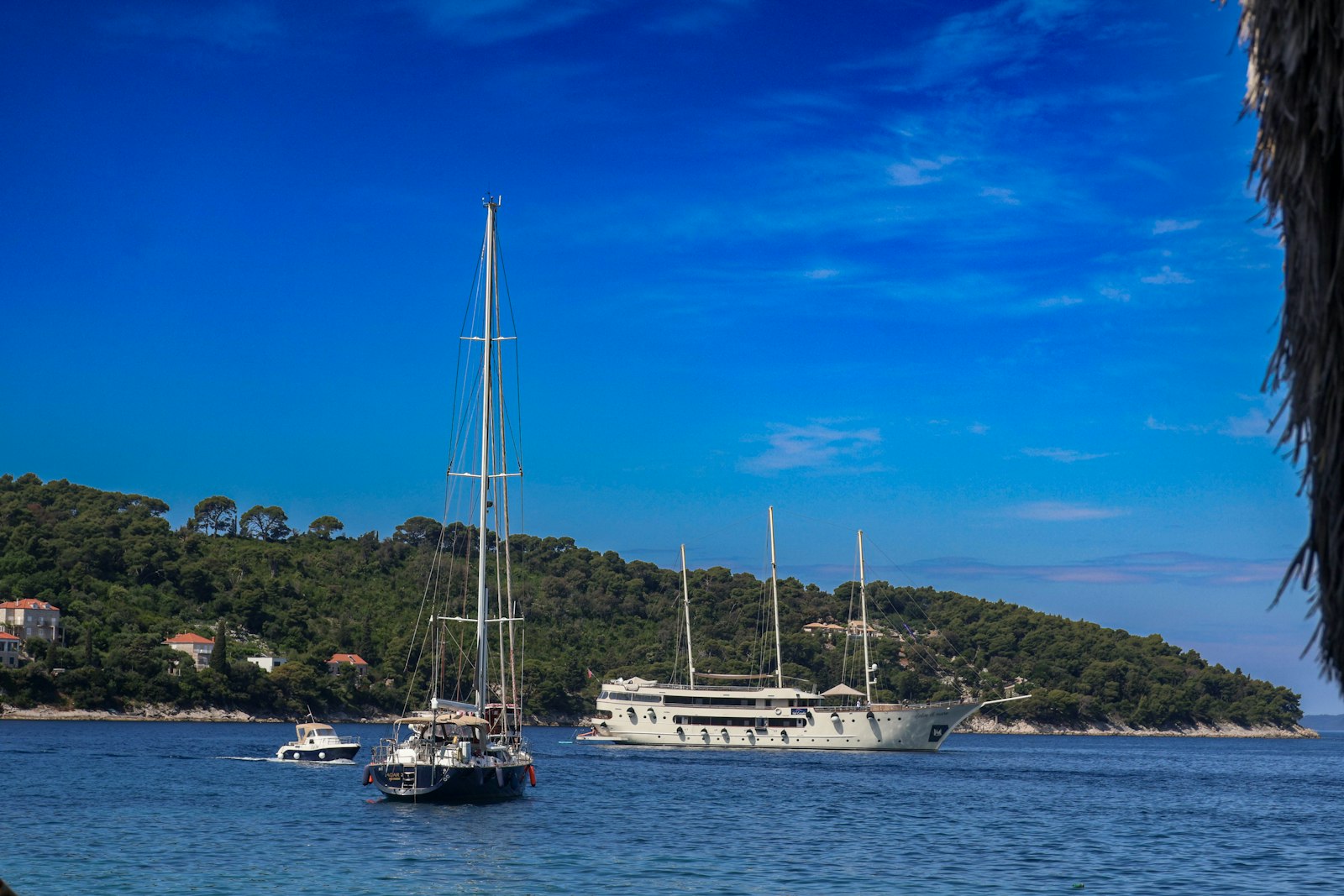
Anchoring is the cheapest and best part of a Croatian charter, and it is also the part most crews do least, because a marina is predictable and a bay requires a decision. The decision is not difficult once you know which bays work, which are managed, and which wind each one hides from.
What follows is the useful list for the water between Trogir and Vis, plus the rule that matters more than any individual bay.
The rule: protection is directional
Start here, because it is where crews get caught.
A bay that is sheltered from the afternoon maestral — the northwesterly that blows every summer day — can be wide open to a night-time bora from the northeast. The wind that made the anchorage pleasant at six in the evening is not the wind that arrives at two in the morning.
So the question is never “is this a good bay”. It is “which direction is this bay protected from, and what is forecast for tonight”. In a strong bora or jugo forecast the honest answer is frequently to take a marina or a solid town quay instead and accept the cost, which is the sort of judgement a skipper makes without being asked.
Close to the bases: the first and last night
Fumija, on Čiovo, is the standard first stop out of Trogir or Split — close enough to reach after a late boarding, with good free-swinging anchoring. It exists to solve the problem of the first evening, when nobody knows the boat yet.
Krknjaši, off Drvenik Veli — the Blue Lagoon — is thirteen miles from Split and sheltered by two small islets, and it tops more than one published list of anchorages in the region. The water is the colour the name suggests. It is also extremely busy in July, so arrive early or come in the shoulder season.
Šolta
Šešula, near Maslinica on the western end, gives good protection from the maestral with decent holding, and the konobas ashore provide mooring lines or buoys — which means dinner and a secure night in one transaction. It is the best-value anchorage on Šolta and one of the few places in central Dalmatia that still feels small in August.
Nečujam is wide and open, which makes it comfortable in settled weather and the wrong choice if anything is forecast.
Brač
Lučice, on the south side, is a branched bay with buoys and real protection from the west. One of the best overnight stops on the island.
Bobovišća is a narrow fjord-like inlet with moorings and limited room to swing — very calm at night, and worth taking a buoy rather than anchoring.
The southwestern coast generally is dotted with small secluded bays that work for an overnight in settled conditions, and they are where you go when the famous places are full.
Hvar and the Pakleni islands
This is the busiest anchoring area in Croatia and it needs the most care.
The Pakleni islets off Hvar town hold a series of managed bays with buoys. Vinogradišće, on St Klement, is the best known: clear water, good shelter, good restaurants, and consequently very crowded. The practical notes matter here — the bottom is sand and the anchor holds poorly, so the safer approach is to lie off the eastern or western shore with a line ashore rather than swinging on your own hook.
Near Carpe Diem beach and in front of the Hula Hula bar are the lively options for an afternoon. Neither is where you want to spend the night; move to a quieter bay afterwards.
In strong southerlies the whole southern side becomes untenable, and the answer is the northern side of Hvar or back towards Brač. The Hvar run covers the approach.
Vis, and further out
Rogačić on Vis is the one with the submarine tunnel — a well-preserved Cold War pen cut into the rock, which you can anchor off and explore. Vis generally is the furthest-out island in the group and correspondingly emptier, which is why crews who get there tend to stay two nights.
The mainland side
Underused, because everyone heads for the islands.
Sveti Nikola, or Fort Bay, near Rogoznica, gives calm conditions with good holding in six to eight metres. Uvala Stupin is similarly calm with sandy or muddy holding. Dvernik Veli is a large quiet bay that takes more than twenty boats without feeling crowded.
These are the fallback when the island anchorages are full, and they are a short hop from Primošten and Šibenik.
Buoys, fees and national parks
Most of the good bays in Croatia are now managed by concession holders who maintain mooring buoys and charge for them, typically in the region of €20 to €80 a night depending on the place and the boat. Pure anchor-only bays still exist but are less common in the busy areas.
Where the buoy comes with a restaurant, the fee is frequently reduced or waived if you eat there, which is a genuinely good arrangement and the point of it. The full picture of what a night costs — anchor, buoy, town quay, marina — is in mooring fees.
In national parks the rules are stricter: in the Kornati, anchoring is permitted only in designated bays or on buoys, and a park fee applies to being in the water at all. The local charges covers it.
Boat type changes where you can go
This is a real constraint and worth factoring into the booking rather than discovering it.
A catamaran draws very little and can enter shallow bays a keelboat has to pass by, which is the strongest practical argument for the type in this region — and it offsets the berth surcharge, because you spend fewer nights alongside. A Croatian catamaran used properly is cheaper to run than a monohull taken into marinas every night.
A deep-keeled monohull is limited in the shallower bays and better suited to the ones with buoys. A motoryacht can reach more bays per day but needs its generator running for air conditioning, which makes a quiet anchorage less quiet — one of the quieter arguments for sail in this particular cruising ground. If the type is open, the route through the options comes first.
A workable pattern for a week
Two nights at anchor, one on a buoy with dinner ashore, one in a marina for laundry, water, power and a shower. That mix costs a fraction of seven marina nights and is a better holiday, and it is the single biggest lever on a Croatian charter budget — see what a week actually costs.
Two practical habits make it work. Plan shorter legs, because crews who motor all day arrive late and take the expensive berth by default. And on a skippered boat, say you would rather anchor — left to themselves, skippers take marinas because they are predictable.
Verify depths and holding against current charts and a pilot guide rather than any list, including this one; bays silt, buoys move and concessions change hands. The routes these anchorages sit on are in a seven-day Croatian itinerary and the islands near Split, and the wider fleet at Croatia and the Adriatic.