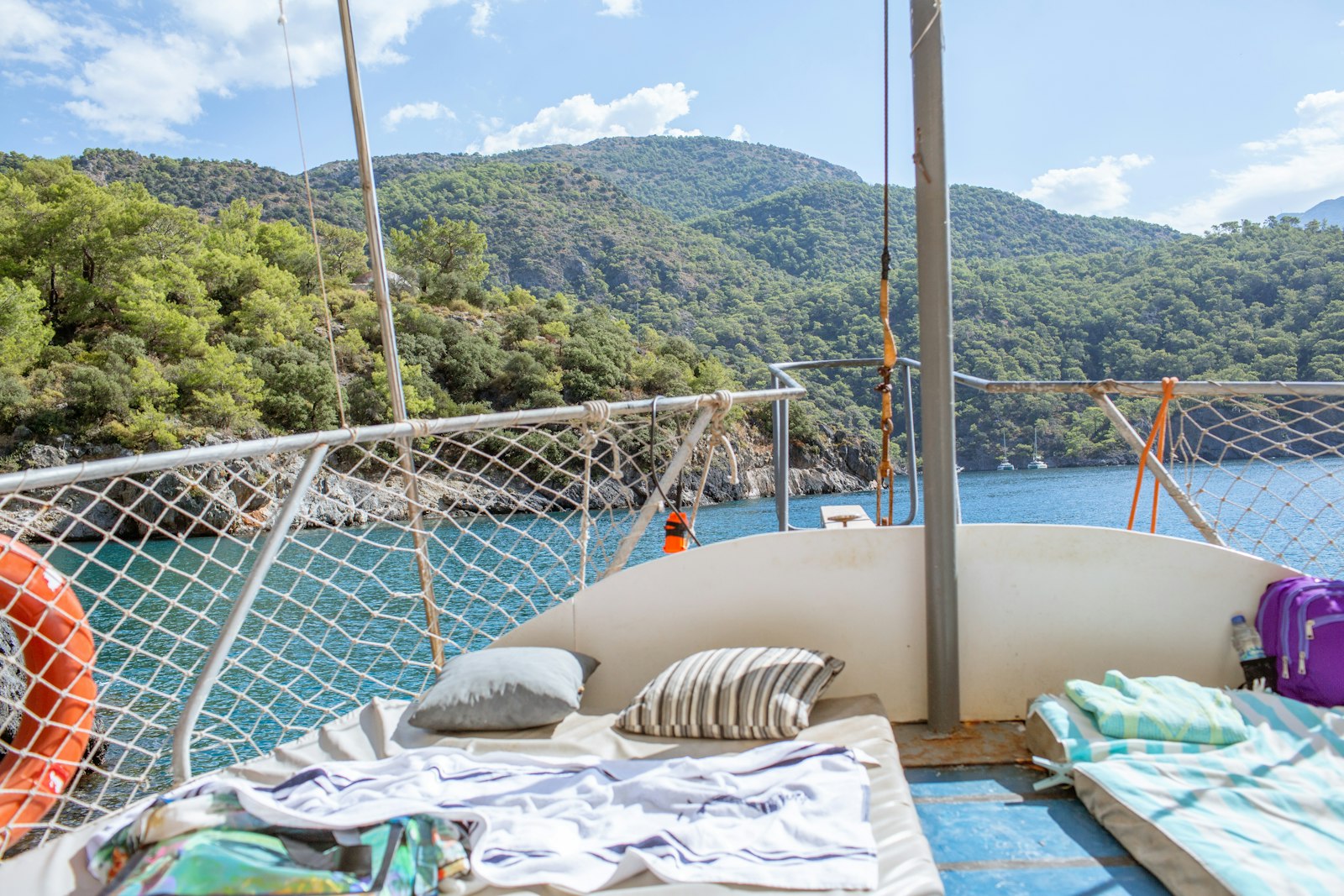
Taking a one-year-old on a charter sounds either obvious or insane depending on who you ask, and both camps are arguing about the wrong things. The decision comes down to four practical matters — the life jacket, the netting, the shade and the boat type — and once those are settled it is a very good holiday.
Everything else is packing.
The life jacket is the whole safety conversation
Do not rely on the boat’s supply. Charter inventories are specified for adults and whatever children’s jackets exist are usually the wrong size and worn out. Bring your own.
It must be certified — CE in Europe, Coast Guard in the United States — and it must be fitted before you travel, not on the pontoon. The test is simple: lift the child’s arms. The jacket should not ride up into the chin or over the ears, and raising the arms should not be a struggle.
Sizing is by weight, and one common guideline is not to take an infant on a boat until they are above about eight kilograms, because below that the jacket cannot fit properly. That is a real constraint and the one worth checking against your own child’s weight before booking.
The rule aboard is unambiguous and easier if it is never negotiated: the jacket goes on whenever the child is on deck.
Netting, and the boat you actually want
The second thing to arrange is a physical barrier. Guardrails are spaced for adults and a toddler goes through them without effort.
Most charter operators will fit safety netting along the guardrails if you ask when booking — it is a standard request and usually free or nearly so. Ask explicitly, in writing, and confirm it again before you pay the balance, because it is the kind of thing that gets forgotten.
Also look at freeboard. A boat with high sides provides a wall between the deck and the water, which contains a small child in a way that a low-sided boat does not.
And a lifeline with a short tether lets a toddler move around the cockpit without being held, which is the difference between a relaxed adult and one who spends the week holding a wrist.
Why a catamaran, specifically
The family recommendation is consistent across the industry and it is correct for reasons that are easy to underestimate until you have tried the alternative.
A catamaran heels a few degrees rather than twenty. On a monohull under sail, a toddler on a sloping deck is a constant hazard and the adults are constantly bracing. On a catamaran the floor stays flat, which means a child can sit and play and an adult can put down a bottle.
The cockpit and saloon are also on one level, so the child is in sight from everywhere rather than down a companionway. The shallow draft gets you into bays where you can swim off the back. And the trampolines forward are a safe enclosed space once netted.
The costs are real — a higher rate, a berth surcharge of 50 to 100 per cent, two engines — and for a family they are the right spend. What a catamaran costs and mooring fees set that out, and chartering with a family covers older children.
The other answer, if open water is genuinely unwelcome, is a houseboat on flat water — no swell, no heeling, no sails. What a houseboat holiday involves covers it, and for a one-year-old it is the most relaxed option on the list.
Shade, sun and heat
Small children burn and dehydrate much faster than adults, and a boat is a reflective surface under an unbroken sky.
What to bring: wide-brimmed hats with a neck tether, UV suits rather than relying on sunscreen alone, and baby-safe high-factor sunscreen. What to check on the boat: whether the bimini actually covers the cockpit at midday, which is a question worth asking with a photograph rather than a yes.
In the other direction, temperature drops quickly at sea and in the evening. A blanket, a fleece and a dry towel are not optional, even in August — cold small children get miserable fast, and hypothermia is a genuine risk on a wet passage. What to bring covers the general list.
Season matters here more than for adults. June and September give warm water with less brutal midday sun than late July, which for a family is the right trade — see when to sail in Croatia and how season bands work.
Sleep, and the protected spot
Bring a travel cot, a bassinet or a soft carrier. Cabin berths are not designed for a baby and a child who rolls will end up on the floor; most parents end up using the saloon or a lee-cloth arrangement, and having your own solution removes the improvisation.
Set aside one secure place aboard — a corner of the cockpit, a cabin with the door shut — where the child goes when the adults are busy. Docking is the moment this matters: everyone is handling lines, nobody is watching, and that is precisely when a toddler explores. A baby monitor with a camera is a genuinely useful thing to pack.
Familiar comfort items help more than anything: a blanket, a specific toy. The boat is strange and the routine is strange, and one familiar object does a surprising amount of work.
What to pack, specifically
Bring more than you think, because resupply is the thing that fails. Island shops carry what islanders buy, and a particular formula or nappy size is not it.
More nappies and wipes than the trip needs, plus formula or bottles with a margin. Running short on day four in a village with one shop is the classic mistake.
A child-appropriate medicine kit and a small first aid kit of your own. The boat’s kit is specified for adults and for cuts, not for a temperature at two in the morning.
Familiar food. A toddler who will only eat three things will still only eat three things at sea, and two of them will not exist in a Dalmatian konoba.
Toys that work in a confined space, and a few more than you think. Boredom arrives faster aboard than ashore, and a bored toddler in a cockpit is the whole crew’s problem.
Provisioning properly before departure is the single most useful preparation — see how to stock a boat, and note that many operators will shop for you from a list if you ask when booking. If anybody else aboard has dietary requirements, the same conversation covers both.
What the week actually looks like
Different from a childless charter in shape rather than in quality, and worth picturing honestly.
You move in the morning and stop by early afternoon. You anchor more and berth less, because a bay with swimming off the back is better for a small child than a quay with traffic on it — which also saves money, as in mooring fees and the pattern in the anchorage guide.
Naps happen underway, which is the unexpected advantage: engine noise and gentle motion put most small children to sleep reliably. Evenings are aboard rather than in restaurants, so the galley matters and a cruiser or catamaran with a real saloon beats a narrow monohull.
And you will not cover the mileage you would otherwise. That is the actual trade — not safety, not comfort, but range. A week becomes four islands instead of seven, which is why the sheltered close-packed cruising grounds suit this trip and the long-passage ones do not.
How to sail differently
Short legs. Two hours rather than five. Mornings, when the sea is flattest — the afternoon thermal that makes for good sailing also makes for a bouncy ride.
Avoid open-water passages until you know how the child reacts to motion. For seasickness in a small child, ask your paediatrician before you travel about whether anything is appropriate and at what dose — do not improvise with adult remedies. The motion question covers the adult version.
And consider a day charter first. Eight hours tells you most of what a week would, and if it goes badly it is over by dinner. A great many families book a week the following year because a day worked.
Before you book: the five questions
Ask the operator: can you fit netting on the guardrails; does the bimini cover the whole cockpit; is there a generator so air conditioning runs at anchor overnight; what is the freeboard; and is a cot available or should we bring one.
On a skippered or crewed boat, tell them a baby is aboard when you book rather than on arrival. It changes how they plan the route, how early they aim to be moored, and which bays they choose — all of which is to your advantage. What a skipper decides covers how much of the week that shapes, and the three formats the choice itself.
The regions that suit this best are the sheltered ones: the Ionian, with two-hour hops and no meltemi, and the channels of northern Dalmatia — Lefkada catamarans and Croatian catamarans are where to look. Avoid the Cyclades and the Dodecanese with a baby aboard; the wind is not the place to find out. The wider fleets are at Croatia and Greece.