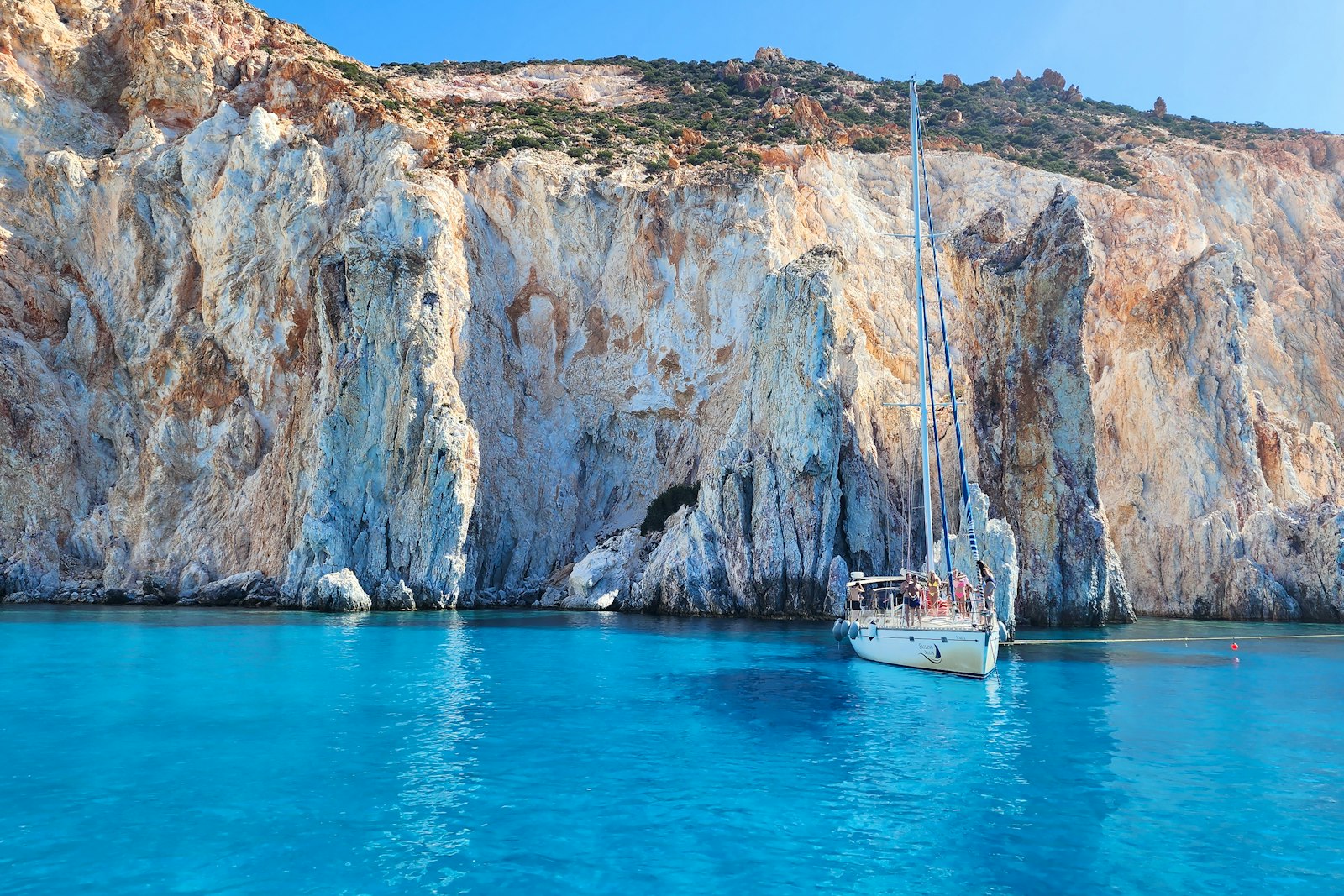
The Dodecanese are the Aegean’s other island group — the one people reach after they have done the Cyclades and want the same light with fewer boats in it. Kos sits in the middle of them, which makes it the obvious base, and the sailing works in both directions from the marina gate.
It is also the Greek charter area closest to Turkey, which is simultaneously its most interesting feature and its biggest administrative trap.
The base
Kos Marina is where almost all charters now start, rather than the old harbour by the castle. It is a full-service marina with a chandlery, supermarkets and restaurants, which matters more than it sounds: provisioning for a week in the Dodecanese is easier here than anywhere else in the group.
The airport is about thirty minutes away, with direct European flights through the season. That combination — short transfer, proper provisioning, central position — is the whole case for the base.
Kos port in town is the alternative, used by day boats and some smaller craft, and it puts you under the castle walls in the middle of everything.
Fleets here are mid-sized: typical charter boats run from around thirty to fifty-four feet, with bareboat, skippered and crewed options all available. Kos as a whole has a reasonable depth of choice, though less than Athens.
Northwest: Kalymnos, Leros, Lipsi, Patmos
This is the classic route and the gentler of the two.
Kalymnos is the first island, an hour or two out, mountainous and now an international rock-climbing destination — which gives the harbour at Pothia an unusual mix of sailors and climbers. It was the sponge-diving island, and the town still shows it.
Leros follows, with Lakki’s extraordinary Italian rationalist architecture — the island was an Italian naval base in the 1930s and the buildings are unlike anything else in Greece. Agia Marina on the other side is the usual mooring.
Lipsi is small, quiet and about thirty-five miles northwest of the marina, with mooring in the village harbour. It is the island people remember.
Patmos is the furthest of the four and the one with weight: the cave where St John is said to have received the Book of Revelation, and a fortified monastery above a white hill town. Reaching it and returning is a full week by itself.
South: Nisyros, Tilos, Symi
The southern loop is the more dramatic and slightly harder option.
Nisyros is a live volcano. You anchor at Palon, take a taxi up, and walk down into the caldera onto ground that is warm and smells of sulphur. There is nothing comparable in the Aegean.
Tilos is quiet, green by Dodecanese standards, and has almost no tourism. Livadia is the harbour.
Symi is the one on the postcards: Gialos, a horseshoe harbour ringed by tiers of neoclassical mansions in ochre and terracotta, built on the sponge trade. It is deservedly busy, and you want to be moored by mid-afternoon in season.
A standard seven-day southern loop runs roughly Kos, Kalymnos, Nisyros, Symi for two nights including Panormitis, Tilos, and back — about a hundred and forty-three miles. A variant swinging west towards Syrna near Astypalaia covers a similar distance. Either is a real week’s sailing, with several legs over four hours, and neither leaves much time for lying around.
A longer, one-way option runs down the chain to Rhodes — Kos, Lipsi, Kalymnos, Nisyros, Tilos, Symi, Rhodes — which is the best route in the group and requires a drop-off fee. How one-way charters work covers that, and Rhodes as a base the other end.
The meltemi, which shapes everything
The Dodecanese get the meltemi from June to September, and this is not a detail. It is a strong, persistent northerly that can reach thirty knots in the channels between islands, and it blows for days rather than hours.
What it means in practice: the northwest route is a beat going out and a fast run coming home, or the reverse, and you plan the week around which direction you want the hard day. Harbours on the northern sides of islands become uncomfortable. And a day in port waiting is a normal part of an August week here rather than a failure.
It also makes this a poor choice for a first charter. How the meltemi behaves is required reading, and a crew without open-water experience should take somebody who knows the group. If you want Greek islands without this, the Ionian is the answer — Lefkada and Corfu are the sheltered half of the country.
The compensation is that the meltemi eases markedly from mid-September, and late September and early October here are superb: warm water, clear air, empty harbours. The autumn case is in sailing in October and November, and the Dodecanese hold their season longer than the Cyclades because they sit further south.
Turkey, two miles away
Kos is close enough to Bodrum that you can see it, and people ask every week.
The answer is that it is a formal exit from and re-entry to the European Union with clearance at both ends, and the great majority of charter boats are not permitted to leave Greek waters. It must be agreed with the operator before booking. Some sources suggest practical courtesies for sailing near the Turkish coast, but proximity is not permission and improvising it is how a holiday becomes a customs problem.
If the Turkish coast is what you want, charter from Turkey. The Turkish fleet is deep, the gulet tradition is based there, and chartering in Turkey covers it. The paperwork side is in the charges and documents.
Which boat
The wind and the passage lengths argue for a capable boat rather than a comfortable one.
A sailing yacht from Kos in the low forties is the standard and the right tool: enough waterline for a windy beat, small enough for the village quays. The Greek economics apply — lower rates and far lower berthing than Croatia, as in what a Greek week costs and mooring fees.
A catamaran from Kos is the better choice if anyone aboard struggles with motion, because a level deck in a meltemi chop is worth a great deal — see multihulls, what one costs and the motion question. The trade is windage: a catamaran is harder to handle in thirty knots in a tight harbour.
A motoryacht removes the wind from the planning entirely and suits crews who want the islands without the beat, at a fuel cost set out in the fuel policy. If the type is open, the route through the options comes first.
Kos or elsewhere
Choose Kos if you want the Dodecanese from the middle, with both routes available and the best provisioning in the group.
Choose Rhodes if you want the southern islands and a city at the start, and are happy to work northwards. Choose Lavrion for the Cyclades instead, which are starker and busier. And choose the Ionian if the crew want warm water and light wind rather than a sailing challenge.
Across the Greek islands, the Dodecanese are the group that rewards a crew who can sail and punishes one that cannot. Which Greek islands to pick compares the regions directly.