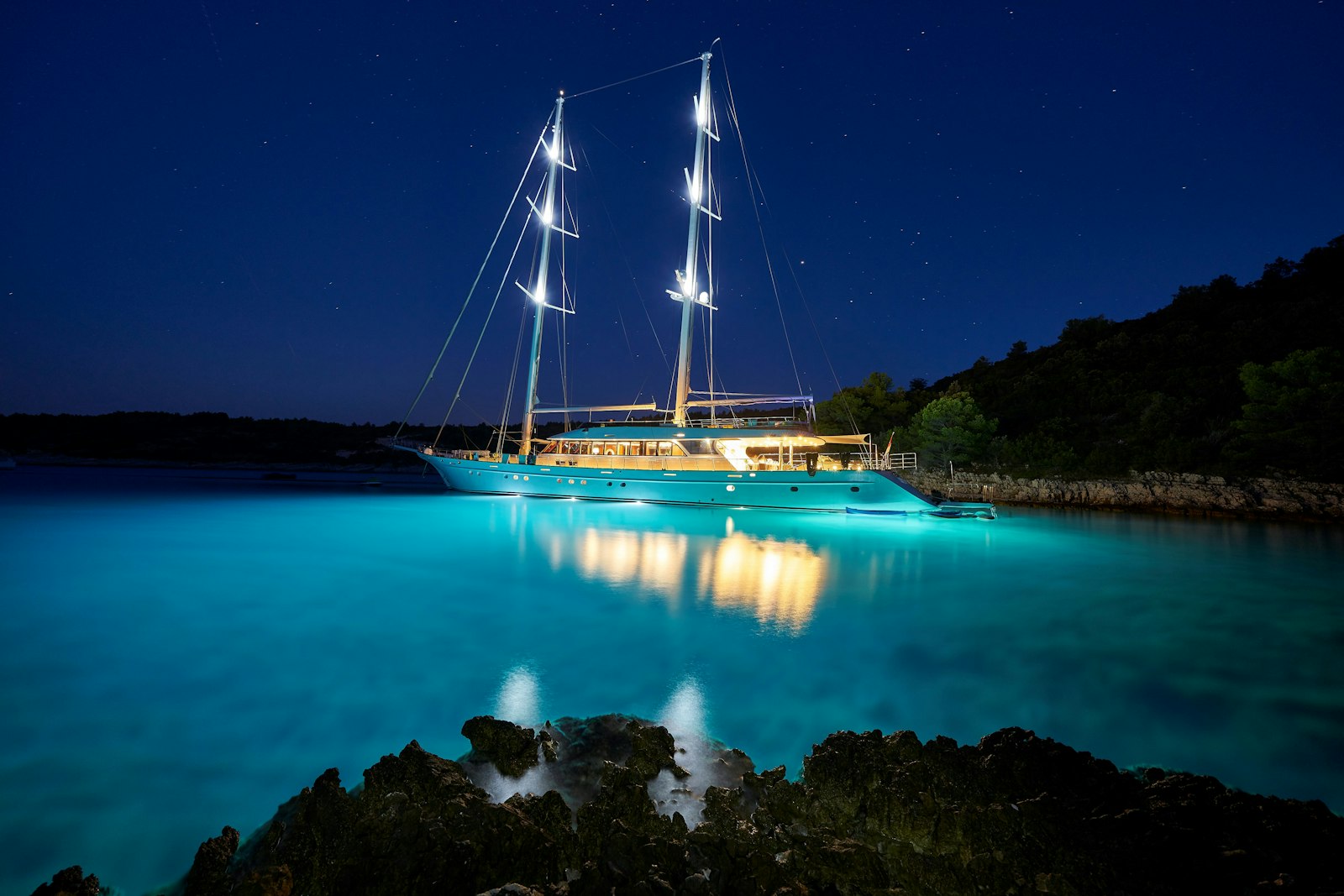
Most charter crews never sail at night, and most charter contracts quietly prefer it that way. But the question comes up every week in one of two forms: can we do an overnight passage, and what happens if we are still out at nine o’clock?
They are different questions with different answers, and the second one catches far more people than the first.
The rule that is actually in your contract
Charter agreements commonly restrict navigation between sunset and sunrise, and many require the boat to be moored or anchored by dusk. It is not universal and it is rarely prominent, which is why people discover it after the fact.
The reason is insurance rather than caution for its own sake. A significant share of collisions happen between sunset and sunrise, and underwriters price accordingly. If your policy excludes night navigation and something happens at eleven at night, the exposure lands on your security deposit and potentially well beyond it.
So the first step is not a seamanship question. Find the clause, read it, and if you intend an overnight passage, get written permission before you book rather than asking at the handover desk. This sits with the other terms worth checking in the contract lines worth reading twice, and the consequence sits with the deposit.
On a skippered or crewed boat the question is the skipper’s and the answer is usually yes within reason — one of the less obvious things a skipper brings.
The problem you will actually have
Not an overnight crossing. Arriving late.
The sequence is always the same. A longer leg than planned, a swimming stop that ran on, a headwind in the afternoon, and suddenly you are approaching an unfamiliar harbour at dusk with a full quay and the light going. Everything that is routine in daylight becomes awkward: judging the gap between two boats, seeing the lazy line, spotting the unlit mooring buoy, reading the depth under the bow.
This is the single most common way a charter day turns unpleasant, and it is entirely avoidable by arithmetic. Decide your arrival time, subtract the passage at realistic speed — not hull speed — and leave accordingly. Add an hour for the mooring, because finding a berth in July takes one.
It gets worse through the season. Sunset moves back by roughly an hour and a half between early September and the end of October, so a passage that finished comfortably in July finishes in the dark in autumn. That is a real planning change, covered alongside the rest in sailing in October and November.
What is different about the sea at night
Three things, and only the third is a real difficulty.
The wind usually drops. On most Mediterranean coasts the afternoon thermal dies at sunset and the night is calm or light. Sailing is often slower; motoring is usually required. That has a fuel consequence worth knowing about — see how fuel is charged.
The sea flattens. With the wind gone the chop goes with it, which makes a night passage considerably more comfortable than the same water in the afternoon. For anyone prone to motion sickness this is counter-intuitive and genuinely useful: the overnight leg is frequently the easiest hours of the trip.
You lose depth perception entirely. This is the one that matters. Distances, closing speeds and the difference between a ship’s light and a shore light all become guesswork. Unlit fishing boats, unlit buoys and fish farms are the real hazards along this coast, and none of them appear on a chart.
Where darkness matters more, by region
The same clock produces different problems depending on where you are.
In Croatia the islands are close and the harbours well lit, so an evening arrival is awkward rather than dangerous. The hazards are unlit fish farms and mussel beds in the channels — common around Šibenik and in the Biograd channels — and they are not where a tired crew wants to be at dusk.
In Greece the Ionian is forgiving: short legs, deep bays, and towns with lights. The Cyclades are not, because the harbours are exposed and a late arrival in a meltemi is a genuinely poor situation. Crews starting from Lavrion should plan arrivals two hours earlier than they think necessary; crews from Lefkada have more margin.
In Turkey and along the Italian coast the difficulty is traffic rather than pilotage — ferries, commercial shipping and, in high season, a great many unlit small boats.
And one practical note for anyone on a motor boat or day boat: planing hulls are the worst possible platform after dark, because speed and no depth perception are a bad pair. Slow down to displacement speed and the problem largely goes away.
Lights, and what they tell you
Worth knowing even if you never sail at night, because you will see other vessels doing it.
Navigation lights are standardised: red to port, green to starboard, and a white stern light. Under sail that is all you show. Under engine you add the white masthead steaming light, which is how another boat knows whether you are sailing or motoring — and therefore who gives way.
What you read from the pattern is the other boat’s aspect. Both red and green together means it is pointing at you. One colour means you are seeing its side. A white light alone usually means you are behind it, or it is at anchor. Everything else in the catalogue — fishing, towing, restricted manoeuvrability — is beyond a charter week, but these three cases are not, and the first one is the one to act on.
Check the lights work during the handover rather than at ten at night. They belong on the same list as everything else in the check-in checklist.
If you do take an overnight passage
Assuming the contract permits it, a few things make the difference between a good night and a bad one.
Set a watch and keep one person on the helm. The convention is that whoever is on watch does not leave the position until relieved. One person, awake, with a fixed handover time.
Guard against falling asleep. Experienced sailors set a timer for twenty or thirty minutes so that if they do drift off, something wakes them. It is not an admission of weakness; it is standard practice.
Do the first one somewhere you know, with a moon. A familiar coast and a bright night remove most of the difficulty. A new coast on a dark night is not where to learn.
Prepare before dark. Reef early, get the sail plan settled, find the torches, put the food where it can be reached, and brief everyone while they can still see. Everything is three times harder once it is black.
Keep the crew warm. It gets cold at sea at night, even in August, and cold people make poor decisions. This belongs on the packing list — see what to bring.
Who should and should not
An overnight passage makes sense if you are covering real distance — a one-way route, a crossing to a further island group, or a delivery leg that would otherwise waste two days. It also makes sense on a motorsailer or a cruiser with a sheltered steering position, where the person on watch is dry and out of the wind. On a catamaran the level deck and the enclosed saloon make night watches far more civilised than on a monohull.
It does not make sense on a standard week in a close island group, where everything is three hours apart and there is nothing to gain. It does not make sense with children aboard, or with a crew of two who will both be exhausted by morning. And it does not make sense at all if the contract forbids it.
For almost every charter week, the honest answer is: do not plan a night passage, and do plan to be moored by six. The evening on a quay with the lights coming on is most of what people came for anyway. If you are still choosing the shape of the trip, a day against a week and the route through the boat types are the earlier decisions, and Croatia and Greece both have island groups close enough that darkness never becomes an issue.