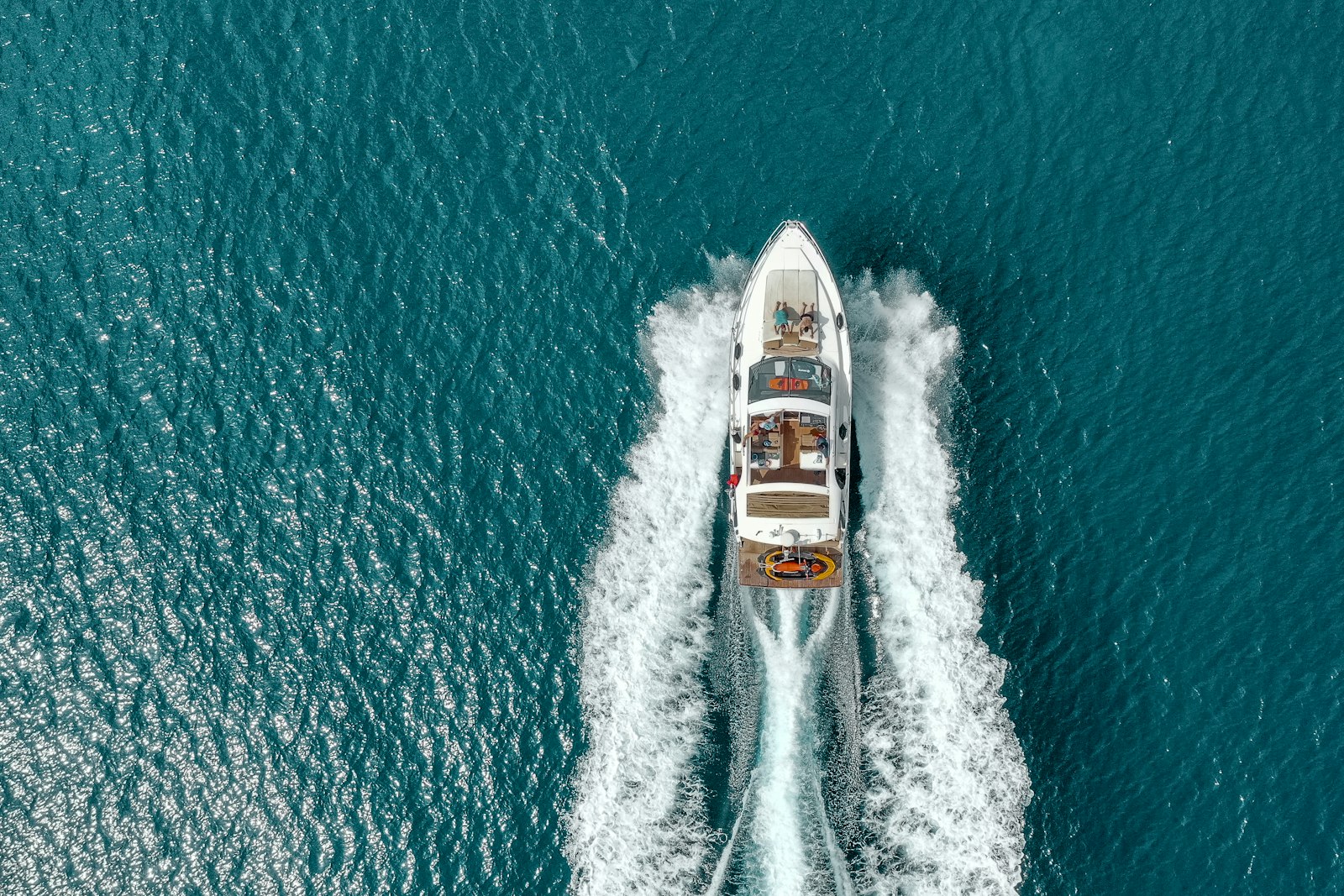
Fuel is never in the charter price, and the way it is charged varies more than any other line on the invoice. Four different models are in common use, they produce very different bills for the same week, and the one argument that reliably happens at the end of a charter happens over this.
The fix is five minutes before you sign: find the words “fuel policy” in the contract and read them.
The four models
Full-to-full. The standard for sea charters. You take the boat with a full tank and bring it back full, refuelling at a station near the base before the final inventory. You pay the pump, so there is no markup and no dispute about rates — only about whether the tank was genuinely full at handover. It is the fairest model and the one to prefer.
A flat fee at check-in. Some operators give up on measurement and charge a fixed amount for the week. Convenient, and it means a crew who sail everywhere subsidise a crew who motor everywhere. If you intend to use the sails, this model costs you money.
Engine hours. The engine has an hour meter; you are billed for the hours you ran it. Common on river boats and houseboats, where there are no sails and consumption is predictable. Rates run in the region of €7 to €13 per engine hour depending on size. Honest, and easy to verify, because the meter is right there.
Quarter tanks. The tank is assessed in quarters at return and you pay per quarter used. This is the model that generates complaints, because a gauge reading “a bit under three quarters” becomes a judgement call made by the person sending the invoice. If you meet it, photograph the gauge at handover and again at return.
What it actually costs
Less than people fear on a sailing boat, and more than they expect on a powered one.
A forty-foot sailing yacht burns roughly five litres an hour under engine. Motor three hours a day for a week and you are at about 105 litres — a sum in the region of €150 to €200. Sail most of the week and it is half that. Fuel is a rounding error on a sailing charter, and that is worth remembering when comparing boat types on headline price alone.
A catamaran has two engines and roughly doubles the figure, which is one of the smaller but real costs of the type, alongside the berth surcharge covered in mooring fees.
A motor boat or a motoryacht is a different order of magnitude. Planing hulls can drink one to three hundred litres an hour at cruising speed. A week of moving properly can exceed the cost of the boat. This is not a reason to avoid power — it is the reason powered charters are planned around shorter hops and more time at anchor, and the reason the fuel line deserves a real number in the budget rather than an allowance.
A motorsailer sits deliberately between the two, and its appeal is partly this: you can motor into a headwind all afternoon without the fuel consequences of a powerboat. What a motorsailer is explains why the compromise exists.
The traps
“Fuel included” rarely means what it sounds like. In most contracts it means the operator pays for the final tank — the refill on return — not for everything you burn. Read the sentence, not the phrase.
The tank was not full. Full-to-full only works if the starting point was real. Check the gauge at handover, in front of the person doing the handover, and have it noted. This belongs on the same list as every other handover check — see the check-in checklist.
The operator’s price, not the pump price. Some bases refuel for you and bill at their own rate. Ask which it is.
Outboard fuel is separate. The tender has its own tank, usually petrol rather than diesel, and it is usually your problem.
The last morning. Check-out is early and the fuel station near the base has a queue of boats doing exactly what you are doing. Refuel the evening before.
Why operators disagree about this at all
It helps to understand why four models exist, because then the one in front of you stops looking arbitrary.
Fuel is the only significant cost on a charter that the operator cannot predict and cannot control. Two crews take the same forty-footer out of the same base for the same seven days. One sails, anchors in bays and burns sixty litres. The other motors from marina to marina against the wind and burns four hundred. Nothing in the booking distinguishes them.
Full-to-full solves that by passing the whole variable to the person who created it, which is why it dominates in sailing fleets. The flat fee solves it by averaging, which suits fleets where behaviour is uniform — day boats doing the same run every day, for instance, or small rental craft on a fixed circuit. Engine hours solve it by metering, which is why river and canal fleets use it almost universally: there are no sails, so engine time is the trip.
Quarter tanks exist because measuring a half-empty diesel tank on a moving boat is genuinely hard. The gauges are floats, they are not accurate, and nobody wants to dip a tank at eight in the morning. It is a pragmatic answer to a real problem, and it is still the model most likely to produce a disagreement.
Deposits, and when fuel comes out of yours
Fuel and the security deposit meet each other at the end of the charter, and this is worth anticipating.
If you return the boat short of fuel, most operators simply deduct the refill from the deposit, usually at their own rate and frequently with a handling charge on top. That is the expensive way to buy diesel. It is also the most common single deduction from a charter deposit that had nothing wrong with it otherwise — how the deposit works covers the rest of what it can be used for.
On a day charter the question barely arises, because fuel for the day is normally quoted inside the price or added as a fixed line, and the boat does not leave your sight. That difference in how running costs are handled is one of several reasons a day charter is a separate product rather than a short week.
Who deals with it on a skippered boat
On a skippered charter the skipper refuels and the cost goes onto the running account, which removes both the queue and the argument. On a fully crewed boat it comes out of the advance provisioning allowance, where fuel and berths are typically the two biggest items — the mechanics are in the APA explained.
What a skipper will also do, if you ask, is sail rather than motor. Left to themselves, skippers on a schedule motor, because it is predictable. Say that you would rather arrive an hour later under sail and the fuel bill and the holiday both improve. This is part of the wider point in what a skipper actually decides.
What to ask before you book
Four questions, in writing: which model applies; whether the boat leaves with a full tank and how the return is measured; whether you pay pump price or theirs; and whether the tender’s fuel is included.
The answers belong with the rest of the pre-booking small print — the deposit, the cancellation terms, the fixed extras. The contract lines worth reading twice covers the others, and what the charter price includes sets the baseline.
And if the type is still open, let fuel help decide it. A week among the Croatian sailing fleet and a week on a Croatian motor yacht are different holidays with different running costs, and so are a Greek monohull and a Greek catamaran. If none of it is fixed yet, the route through the options starts one step earlier, and the country-level budgets are in Croatia, Greece and Italy.