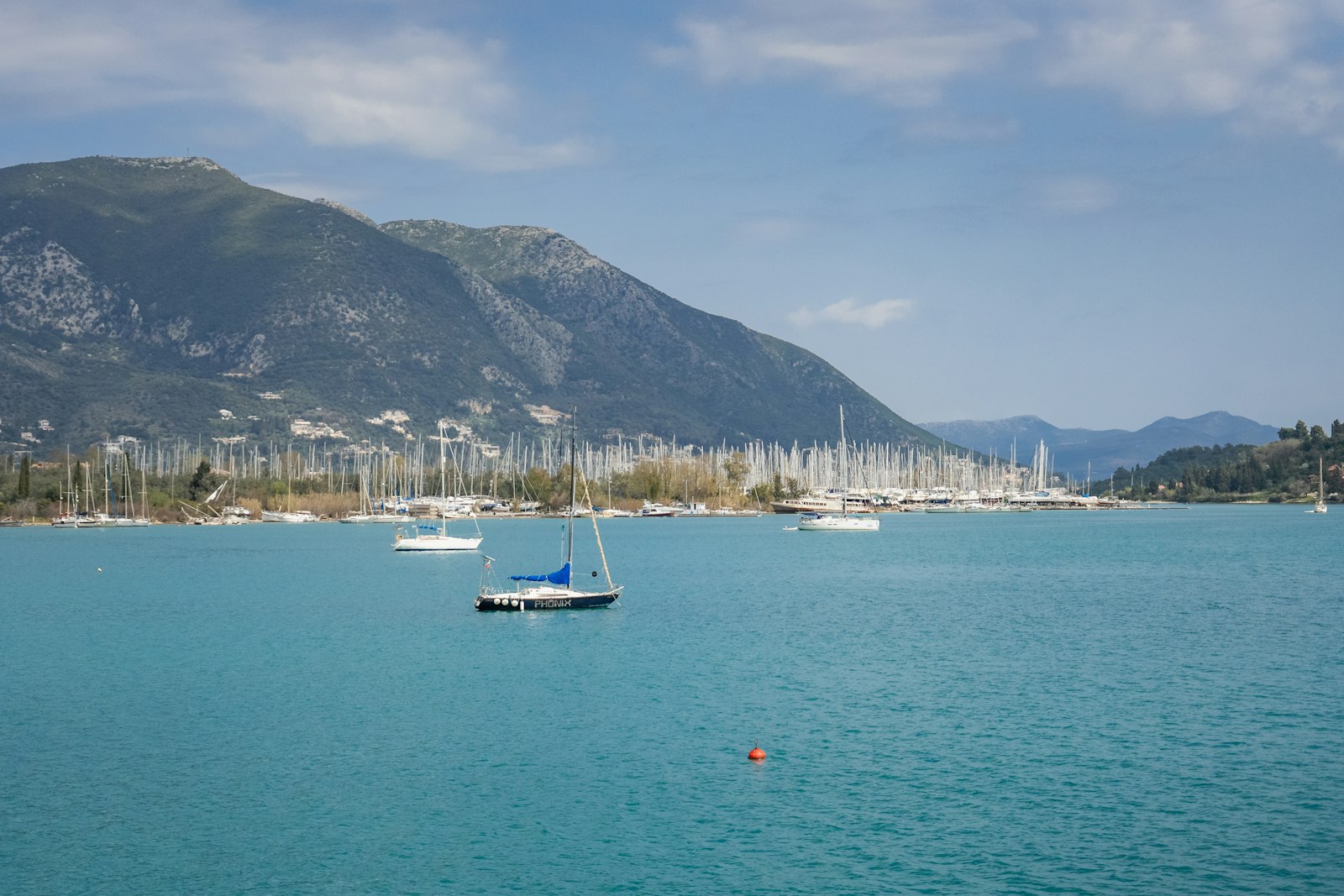
Lefkada has quietly become the most sensible place in Greece to start a sailing week, and the reason is geography rather than marketing. It sits in the middle of the Ionian. Everything worth reaching is within a day, in both directions, and you can change your mind on Tuesday without wrecking the plan.
Operators noticed before the public did. Several moved boats here from Corfu once roughly half their customers were already asking to start from Lefkada instead.
The base, and how you get to it
The main charter base is the marina in Lefkas town, on the island’s eastern side, with room for something over six hundred boats. It is inside the town rather than outside it, which is rarer than it sounds — you can walk from the pontoon to dinner.
The alternatives are smaller and quieter: the town port, Perigiali and Nikiana up the east coast, and Nydri further south, which is the busiest tourist base on the island and a workable starting point in its own right.
The airport is Preveza, about thirty minutes away by road — and Lefkada is joined to the mainland by a short floating bridge, which means you drive to the island rather than taking a ferry. That single fact is why transfers here are so much simpler than to Corfu or Kefalonia, and it is the practical advantage over every other Ionian base.
There is parking at the marina, so arriving by car from elsewhere in Greece is realistic.
Why the Ionian sails differently from the Aegean
This is the thing to understand before choosing between the two halves of Greece, and it decides who should be here.
The Aegean has the meltemi: a strong, persistent summer northerly that dominates planning and can pin a boat in harbour for two days. How that wind behaves is the single biggest variable in an Aegean week.
The Ionian has none of it. The prevailing summer wind is a gentle afternoon northwesterly that builds around midday and dies in the evening — enough to sail properly, rarely enough to frighten anybody. Mornings are often calm. The islands are close together and the water between them is largely protected.
The consequences are concrete: short passages, reliable anchorages, and a week that almost never has to be rewritten because of weather. It is the best water in Greece for a first charter, for families, and for anybody who wants sailing to be pleasant rather than an achievement. If your crew includes somebody who has already had a bad experience with motion at sea, this is where to bring them.
The trade: it is green, soft and intimate rather than stark and dramatic. People who want the whitewashed Cyclades postcard are in the wrong sea — that is the other side of Greece.
South, north, or both
South is the classic week and the busier one. Out of Lefkas down the inland sea past Nydri, into Meganisi, then the choice of Ithaca, Kefalonia, Kastos and Kalamos. Distances are an hour or two. Sivota on Lefkada’s south coast and Fiskardo on northern Kefalonia are the two harbours everybody wants, which means arriving early in August. The wider Ionian picture covers the island group in detail.
North is emptier. Up to Preveza, then the mainland coast towards Parga, and offshore to Paxos and Antipaxos — the latter with water that genuinely looks Caribbean — and on to Corfu if you have the days.
Both is possible in a fortnight and a mistake in a week. The standard error here is the same as everywhere: planning on a chart, where everything looks close, rather than on a clock that includes swimming, lunch and finding a berth.
A good first week, not rushed: Lefkas to Nydri or Vlicho, Meganisi, Kastos or Kalamos, Ithaca, Fiskardo, Sivota, back. Nothing over three hours, every night somewhere worth being.
The inland sea, and why it changes the first two days
South of Lefkas town the water between the island and the mainland is almost enclosed — a long sheltered corridor with Meganisi at its southern end. Locals call it the inland sea and it behaves like a lake.
This has a specific practical value. The first evening of a charter is the one most likely to go wrong: the boarding was late, nobody knows where anything is, and the crew have not sailed together. Here the first leg can be forty minutes to a flat-calm anchorage in Vlicho or Tranquil Bay, which means you learn the boat somewhere nothing can happen. Very few charter areas offer that.
It also means a week can be salvaged. If the forecast turns, you retreat into the corridor and still have somewhere worth being, rather than sitting in a marina. On exposed coasts that option does not exist, which is the quiet reason this region suits crews who have not done it before.
Harbours, anchorages and the evening problem
The Ionian runs on a mix of town quays and bays, and the balance you choose sets both the cost and the character of the week.
Town quays here are mostly free or nearly so — you tie stern-to against the wall, take a line ashore, and pay little or nothing beyond a taverna bill. That is a genuine difference from Croatia, where the same night is a marina charge. It is most of why a Greek fortnight costs noticeably less than a Croatian one at the same boat price.
The catch is competition. Fiskardo, Sivota and Kioni fill in high season, and the boats that arrive at six are the ones motoring onwards. The fix is unglamorous: short legs, arrive by four, or take the bay next door and eat aboard. Crews who plan five-hour days are the ones who end up berthing in the dark.
Anchorages are plentiful, well-sheltered and mostly free, which suits a catamaran with shallow draft particularly well. A long-line ashore is standard practice in the narrower bays here, and it is worth knowing in advance that somebody will be swimming a rope to a rock — pleasant in July, less so in October.
Which boat
The light winds and short hops shape this more than people realise.
A sailing yacht from Lefkada is the default and the fleet is deep. In this wind a mid-size monohull sails well in the afternoon and motors for an hour in the morning, which keeps the fuel figure trivial. It is also where the value is — a Greek week undercuts Croatia at a similar specification, and berths here are roughly half the Croatian rate.
A catamaran from Lefkada is the family answer: level decks, shallow draft for the Ionian’s many small bays, and space for everyone at once. The multihull case and what one costs are worth reading together, because the gap against a monohull is wider than the brochure suggests once berths are counted.
A motor boat makes sense only if you intend to cover the north and the south in one week, which, as above, is ambitious.
For crewed trips the Ionian has a good supply of larger catamarans with skipper and host, and the pricing on those follows the advance-allowance model set out in the APA explained — typically with a quarter of the fee added for running costs and VAT on top.
If the type is still open, the route through the options comes first, and the Greek sailing fleet and Greek catamarans show what is actually free.
Season
May to October, with July and August busy and the harbours full by five. June and September are the best fortnights available anywhere in Greece: warm water, reliable light wind, space on the quay.
October works and runs later here than in the Aegean because the Ionian is sheltered and green — the autumn argument is in sailing in October and November, and the price consequence in how the bands work.
Lefkada or another Ionian base
Choose Lefkada if you want the widest choice from one starting point, the simplest transfer in the region, and a town at the end of the pontoon.
Choose Preveza if you want slightly cheaper and slightly quieter with the same water — it is thirty minutes away and shares the whole cruising area.
Choose Corfu if Corfu town itself is part of the holiday, or if your flights go there; it commits you to the northern half.
And look at the Aegean instead — Athens, Kos, Rhodes — if you want the Cyclades look and will accept the meltemi for it. Across the Greek islands as a whole, the Ionian is the half that forgives a first-time crew, and Lefkada is its middle.