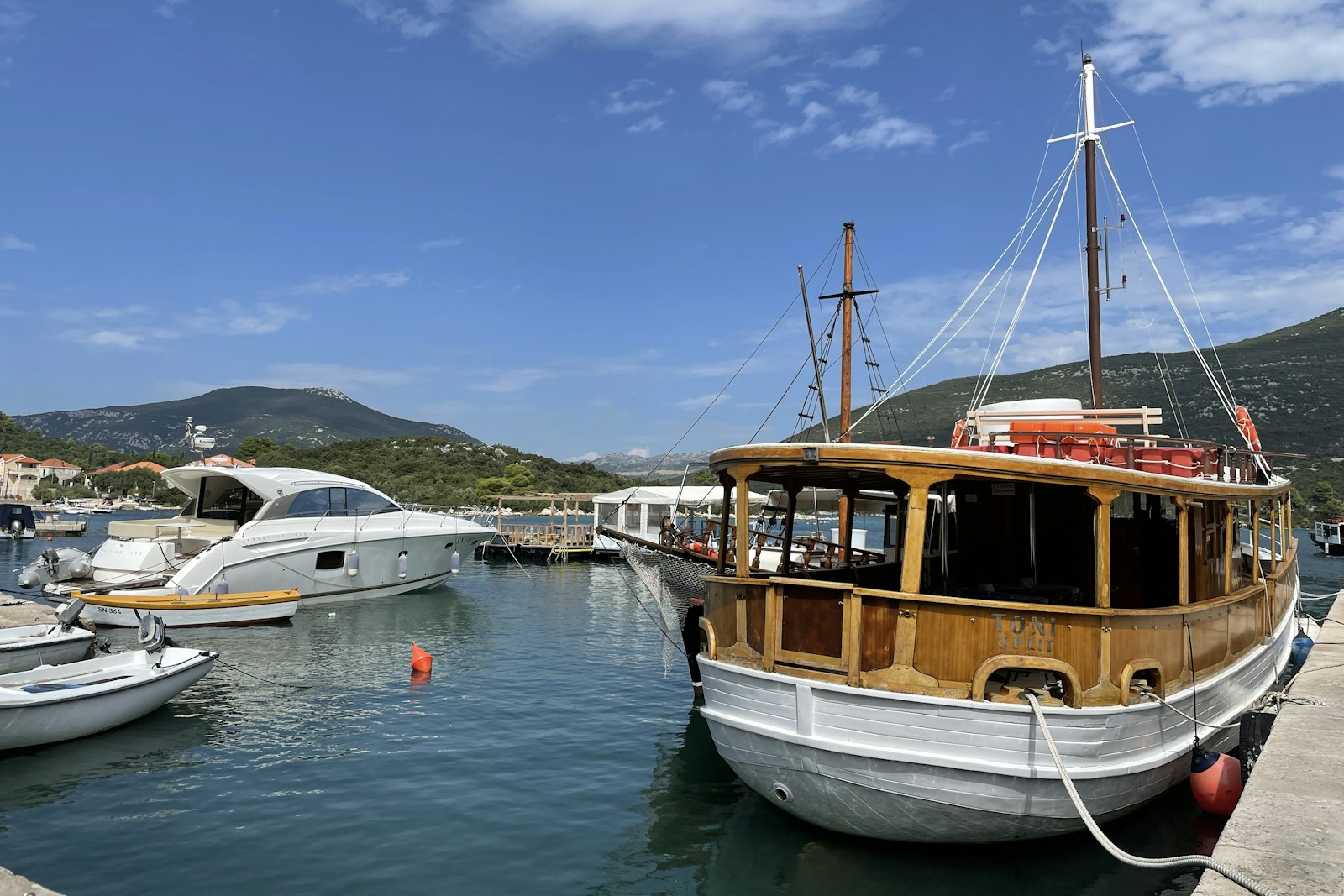
Trogir is the most convenient charter base in Dalmatia, and almost nobody chooses it for that reason. They choose it because the airport is twenty minutes from the boat, and then discover that the town itself is the better half of the deal.
The practical case is simple. Split Airport sits at Kaštela, between Split and Trogir, and it is closer to Trogir than to the city it is named after. You land, you drive west for ten to twenty minutes depending on traffic, and you are at the boat. Charters leaving from Split itself usually mean a longer transfer in the opposite direction, through town traffic that peaks exactly when Saturday flights land.
Which marina you are actually leaving from
“Trogir” on a booking confirmation can mean four different sets of pontoons, and they are not interchangeable. Read the address, not the town name.
ACI Marina Trogir lies across the narrow channel on the Čiovo side, directly opposite the old town. You walk over the bridge in five minutes and you are among the stone streets. It is the most central option and the one people picture when they imagine the place.
SCT Marina Trogir is also on Čiovo, slightly further along, with a large yard attached. Fleets that need lifting and service tend to sit here.
Trogir city port is the quay along the Riva itself — no marina gates, no pool, the town immediately at the gangway. Day boats and smaller craft work from here.
And a good share of “Trogir” charters actually start at Seget Donji, the next settlement west. It is a two-kilometre walk or a short taxi from the old town. Nothing is wrong with it; it simply is not Trogir, and if you planned a first evening on the Riva you want to know in advance.
The Saturday rhythm, and why it is worth planning around
Weekly charters in Croatia run Saturday to Saturday. Boats come back in the morning, get cleaned and refuelled through the middle of the day, and go out again in the late afternoon. Check-in is commonly around five in the evening, check-out around nine in the morning.
That rhythm has consequences. A Saturday flight landing at two in the afternoon is comfortable. One landing at seven in the evening means boarding in the dark, doing the handover by torchlight, and starting the holiday tired. Where the flight schedule is awkward, a night ashore in Trogir before boarding is the cheapest improvement available to the whole trip.
Day charters and short trips do not follow this at all — they run on their own daily schedule, which is one of several reasons a day charter is a different product rather than a smaller version of a week.
What is within reach, day by day
Trogir’s real advantage is that the good water starts immediately. There is no long delivery leg out of a gulf before the holiday begins.
Šolta is two hours away, which makes it a genuine first-night option rather than a compromise. Maslinica on its western end is one of the few harbours in central Dalmatia that still feels small in July.
Brač, Hvar and Vis form the next ring, each a comfortable day apart, and the pattern they allow — out along one island chain, back along another — is the backbone of most sensible week-long routes in Croatia. If your priority is the islands rather than the towns, the islands reachable from this stretch of coast are the same set, approached from a slightly better starting point.
North of Trogir the character changes. Primošten and Vodice open towards Šibenik and, beyond it, the Kornati archipelago — barer, emptier, and better suited to a crew that wants anchorages over restaurants.
The single most common first-time error is planning too much of it. The route to Hvar looks short on a chart and takes a full day in practice once swimming stops, lunch stops and a mooring hunt are counted.
Which boat, and what that choice really changes
Trogir fleets cover the full range, and the type matters more than the length. A sailing yacht from Trogir is the default: economical, plenty of them, and the afternoon thermal wind along this coast is genuinely good for sailing rather than just motoring with the mainsail up. The trade is interior space — see how sailing boats compare across the fleet before fixing on a number of cabins.
A catamaran from Trogir buys stability, shallow draft and a cockpit everyone can sit in at once. It costs more, and it pays mooring fees at a higher rate because it occupies more width. For families and for groups where somebody is nervous about heeling, that premium usually turns out to be the right spend; the wider case for and against multihulls is worth reading before you decide on price alone.
A motor boat or a larger motor yacht from Trogir compresses distance. Vis for lunch stops being ambitious. Fuel becomes a real line in the budget rather than a rounding error, which is why the fuel policy deserves reading on a powered booking in a way it does not on a sailing one. The distinction between a motor boat and a motoryacht is about crew and systems as much as size.
Larger groups sometimes land on a gulet instead. Croatia has a handful of them, though the type is more at home further east, in Turkey, and what a gulet charter actually is surprises people who expect a large sailing yacht.
Season, and the two weeks worth knowing about
July and August are hot, busy and expensive, and every harbour you want is full by four in the afternoon. The sailing is light in the morning and good from midday.
Late May, June and September are better in almost every respect except water temperature, and the gap in price is large enough to change which boat you can afford. The detail of which fortnight to pick is covered in when to sail in Croatia, and the effect of season on the number itself in what a Croatian charter costs.
October still works from Trogir, with shorter days and a real chance of a few grey ones, which is its own calculation — see sailing the Mediterranean in October and November.
Paperwork, borders and the things that catch people
Sailing the waters around Trogir needs no border formalities at all. Everything from Istria to Dubrovnik is domestic.
Crossing to Montenegro is a different matter: it is an exit from the European Union and back, with clearance at both ends, and it must be agreed with the operator before you book rather than decided on board on a Tuesday. Most Trogir-based boats are not permitted to leave Croatian waters.
The standing costs that are not in the headline price — tourist tax, the transit log, the security deposit — behave the same way here as anywhere on the coast. The paperwork side and the deposit are each worth ten minutes before departure rather than at the handover desk.
Is Trogir the right base for you
Choose it if you are flying into Split, if you want the holiday to start within an hour of landing, and if a walled medieval town at the end of the pontoon sounds better than a city.
Look elsewhere if you want to be further north among emptier islands from day one — Zadar and Biograd answer that better — or if your flights point at Dubrovnik, in which case the southern end of the coast is the sensible read.
Whichever it is, the order of operations is the same: fix the dates, then the boat type, then the base. Doing it the other way round is how people end up with the right boat in the wrong place. You can see what is free for your week across Croatia, narrow it to Trogir, or start from the whole Adriatic and work inwards.