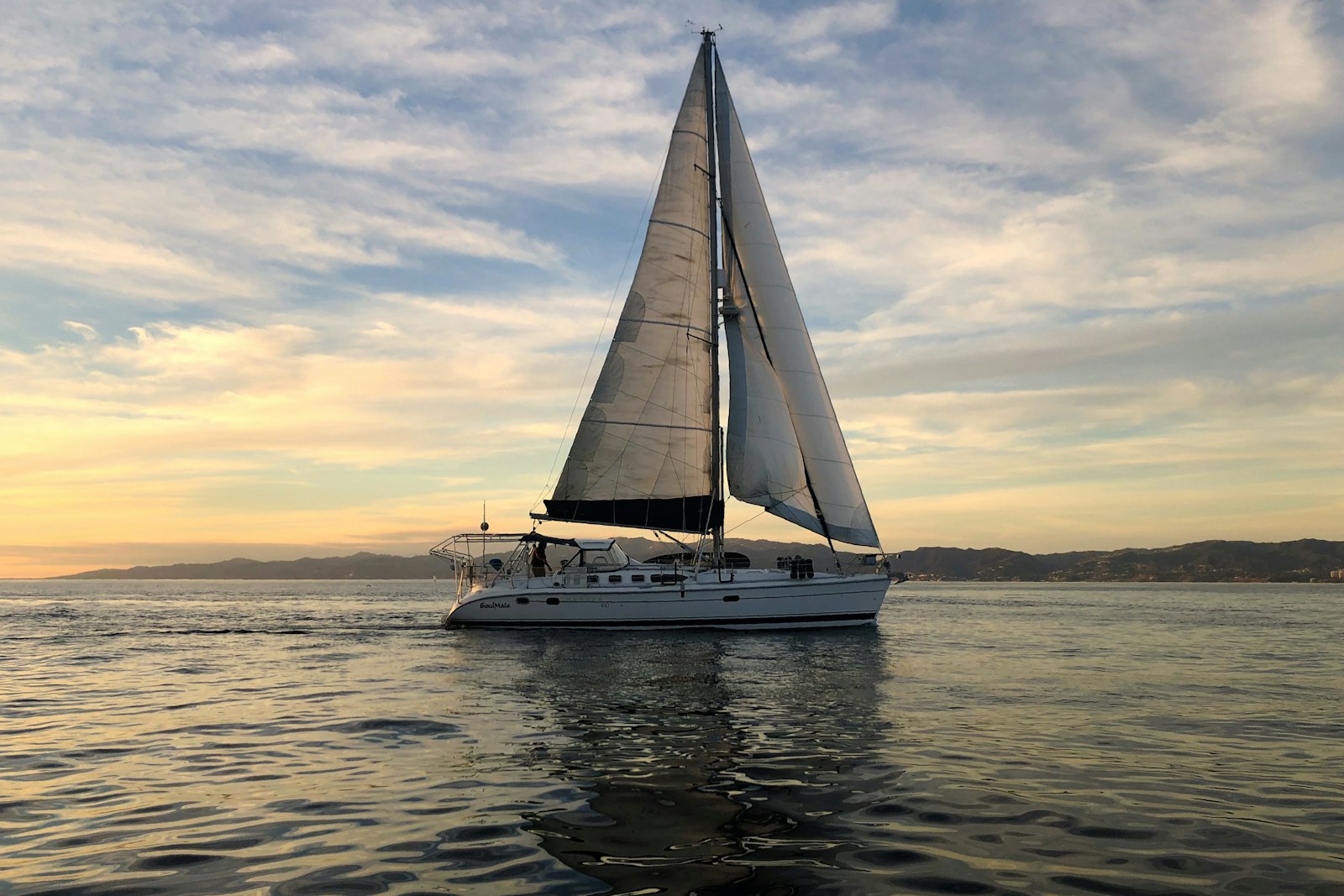
Almost every production sailing yacht in a charter fleet is sold as a cruiser, and a good proportion of them have the word performance attached somewhere. One industry writer put the problem well: nearly every mid-range cruising yacht now carries the performance label, so what does it actually mean?
It means something, but less than the marketing implies, and the difference you will feel on a charter week is not where people expect it.
The honest definition
A cruiser is designed around living aboard. Volume, stability, easy handling, a cockpit you can sit in for a week. Speed is a consequence rather than a goal.
A performance cruiser keeps most of the accommodation and claws back speed and responsiveness through hull shape, sail area and rig control. It is not a racing boat with cabins; it is a cruising boat that has not given everything up.
These are points on a line, not two categories. Boats from Beneteau, Jeanneau, Hanse, Dufour and Elan all appear at both ends of it depending on the model and the options list, which is exactly why the label on its own tells you so little. Reading a model name helps more than reading the adjective.
What is actually different in the boat
Hull shape. Performance designs use a plumb bow and flat aft sections — longer waterline for the same length, less drag, more speed. Cruising designs carry more volume forward for interior space and are slower for it.
Sail area. More canvas, and better-cut canvas, on the faster boat. In light airs this is the difference between sailing and motoring.
Rig control. This is the one that matters most and gets mentioned least. A cruiser typically has a fixed backstay. A performance boat has an adjustable one, which lets you flatten and depower the mainsail from the cockpit. In a rising afternoon breeze that single control is the difference between a comfortable boat and an overpowered one.
Keel and draft. Deeper keel, more ballast, better grip to windward. Modern cruisers frequently trade draft for interior volume, and the result is a boat that slides sideways on every beat — leeway you can see on the chartplotter. Shallow draft has its own virtues in a bay, so this is a genuine trade rather than a defect.
Build and interior. Performance cruisers are not spartan. Several brokers note the interiors are often better finished and the boats better built, because the buyers are more demanding. The label does not guarantee it; the specific boat either has it or does not.
What you will actually notice on a charter week
Less than the brochures suggest, and in specific places.
On a typical Mediterranean week the difference between a cruiser and a performance cruiser of the same length is maybe half a knot of average speed. Over a four-hour leg that is twenty minutes. Nobody’s holiday turns on twenty minutes.
Where you notice it is upwind in a breeze. The performance boat points higher and makes better progress; the cruiser slides and has to tack more. On a route with a prevailing headwind — the northwest run in the Dodecanese, or an open-water leg along the Istrian coast — that is the difference between arriving at four and arriving at seven.
And you notice it in light air. In six knots of breeze the cruiser is motoring and the performance boat is still sailing, which is most of the morning in July.
What you do not notice: comfort below, which is roughly equivalent on modern boats of the same size, and handling difficulty, which is more about the sail-handling gear than the hull.
How the two get sailed differently
This is a real and underappreciated point, and it is about the crew rather than the boat.
Cruising sailors reef early — well before the boat demands it — and willingly give up speed for comfort. Performance sailors keep driving, holding full sail until conditions genuinely require otherwise.
Which means a performance boat sailed by a cruising crew is simply a cruiser that cost more, and a cruiser sailed hard is a perfectly quick boat. The boat sets the ceiling; the crew decides where in the range you live. If nobody aboard wants to trim a sail twice an hour, buy the volume instead.
What to look for instead of the label
Five things in the listing tell you more than the word performance.
Draft. Deeper is faster upwind and worse in bays. Decide which you care about, because it is the clearest single indicator.
Backstay, adjustable or fixed. Mentioned in specifications and rarely in the headline.
Mainsail type. A full-batten main on a traditional slab-reefing system sails better; in-mast furling is far easier and costs you shape and area. For a charter crew, furling is usually the right compromise and it is also the honest marker that the boat is a cruiser.
Winch count and whether they are electric. Decides how much work the sailing is, which decides whether anybody does it.
Model year. A newer cruiser frequently outsails an older performance boat, and costs less than a new one. The age effect on price is in how charter prices are built.
Which to book
Take a cruiser if the week is about the places rather than the sailing; if the crew includes people who are along for the ride; if you want the cockpit to be a living room; or if you are chartering in a close island group where legs are short and the engine covers the gaps. In Croatia and the Ionian this is the right answer for most crews.
Take a performance cruiser if somebody aboard genuinely wants to sail and will keep trimming; if the route has long open-water legs or a reliable headwind; or if you have chartered before and come back frustrated by how much of the week was spent under engine.
Take neither if stability is the real requirement. A catamaran solves the heeling problem that a monohull of either flavour does not — see the three-way comparison and the multihull options. And if weather shelter is what you are after rather than speed, a motorsailer is the cheaper and better answer — what that type is explains why.
The wider decision sits in the route through all eleven types, and both flavours of monohull are throughout the Mediterranean fleet — Croatian cruisers, Italian monohulls and Spanish ones all carry the same models with different options.
One last practical note
Whatever the label says, the thing that determines whether you enjoy the sailing is how easy the boat is to handle with the people you actually have. A performance boat with four willing sailors is excellent. The same boat with one sailor and five passengers is a lot of work for one person and an anxious week for everybody.
If the crew is mixed, either take the cruiser or take a skipper, who will get more out of either boat than an under-crewed cockpit will. The three formats covers that choice, and the licence question settles whether it is even optional.