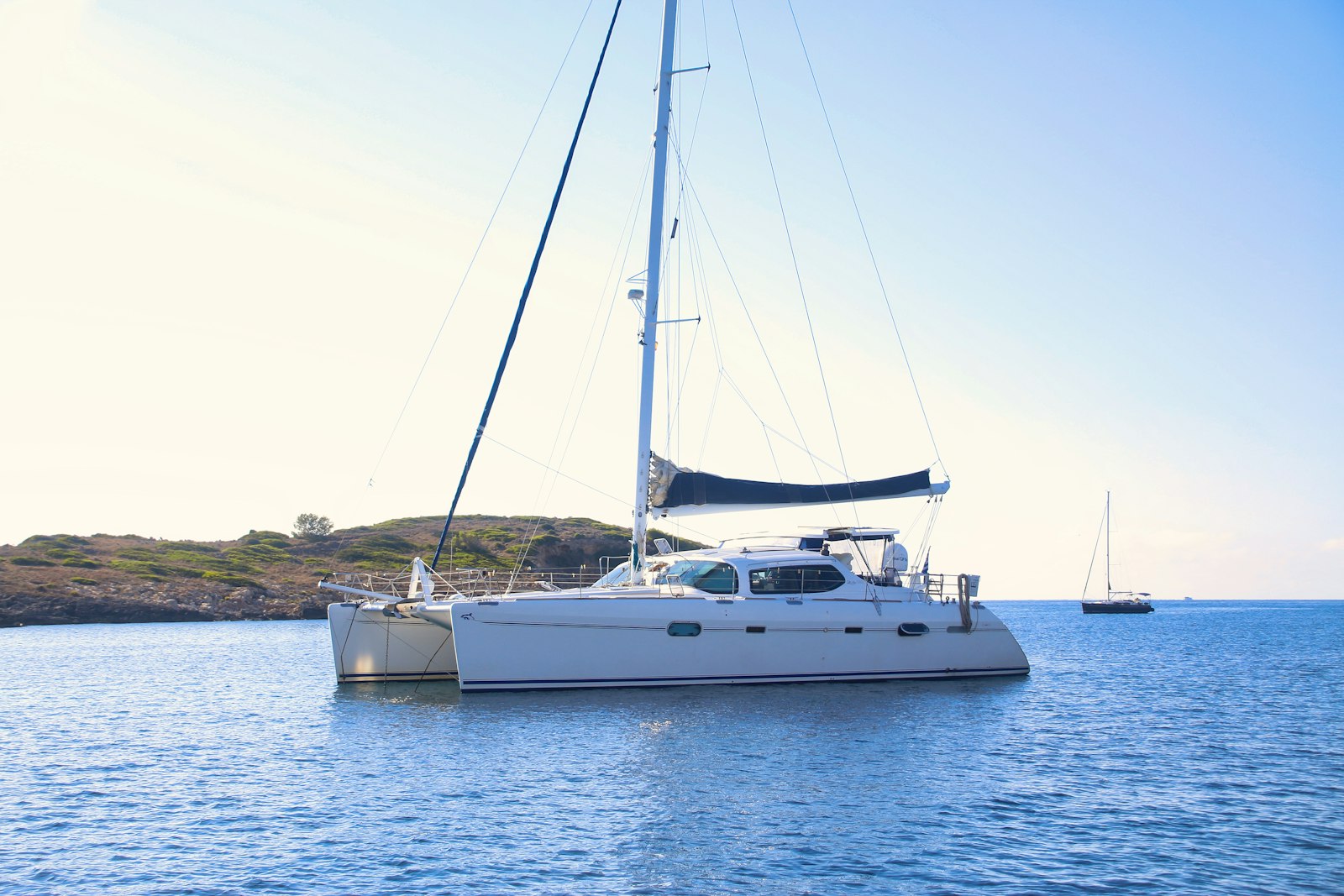
Both are multihulls, both stay far more level than a monohull, and both are rare enough in charter fleets that you may never be offered the choice. Where you are, the decision comes down to one trade: living space and ease against speed and feel.
The structural difference, and what follows from it
A catamaran is two hulls of equal size with a deck bridging them. A trimaran is one dominant central hull with two smaller floats — amas — carried out on beams either side.
That single difference produces everything else. On a catamaran the accommodation lives in both hulls, so the designer has two long narrow spaces to put cabins in and a wide bridgedeck for the saloon and cockpit. On a trimaran the outer floats are too slim to live in, so all the accommodation sits in the centre hull — which means a trimaran of a given length has considerably less interior volume than a catamaran of the same length.
Both appear on charter under the same heading, because multihull covers catamarans, power catamarans and trimarans together. If you want a trimaran specifically you will usually have to ask.
Where the catamaran wins
Living space, decisively. Two hulls plus a bridgedeck is simply more boat for the same length. This is why catamarans dominate family and group chartering and trimarans do not.
Cabin privacy. Putting couples in opposite hulls, with the saloon between them, is the layout that keeps people on good terms through a week. A trimaran’s cabins are all in one hull, adjacent to each other.
Steadiness at anchor. A catamaran is close to immovable at rest. A trimaran, with its weight concentrated centrally, moves more. Over seven nights of sleeping aboard that difference is felt.
Ease of handling. Catamaran systems are deliberately simple and a small crew manages one without drama. Trimaran rigs tend to be more performance-oriented and ask for more active sail management — which is the opposite of what most charter crews want.
Availability. This is the practical clincher. Croatia, Greece, Italy and Spain all have deep catamaran fleets from the main builders — Lagoon, Fountaine Pajot, Nautitech, Leopard. Charter trimarans are a handful of boats in total.
Where the trimaran wins
Speed. Three slender hulls generate less drag than two wider ones, and a trimaran is genuinely quick. For sailors who find charter catamarans dull to steer, this is the answer.
Upwind performance. Trimarans point higher and make better progress to windward than catamarans do, which matters on a route that has to beat into a prevailing wind.
The sailing sensation. A trimaran leans — up to around twenty degrees at speed — and accelerates in a way a catamaran does not. Depending on who is aboard, that is either the best part of the week or the reason somebody stops enjoying it.
Shallow draft with sailing ability. Both multihulls draw little water; the trimaran keeps that while sailing better.
The stability question, answered properly
People ask which is more stable and the answer depends on which kind of stability.
At rest, the catamaran. Its buoyancy is spread across two widely separated hulls and it barely rolls.
Under way in a seaway, the trimaran has an argument: the outer floats act as outriggers that damp roll, and the centre hull cuts through rather than bridging two wave trains. Some sailors find it the more settled ride offshore.
For the thing most charter guests actually mean — will I feel sick, will the plates stay on the table — the catamaran is the safer recommendation, because the heel is minimal and the motion is predictable. Anyone booking for a crew member who struggles with motion at sea should take the catamaran and not experiment.
Power catamarans, the third thing under the same heading
Worth knowing because the multihull category in charter listings contains them and people meet one unexpectedly.
A power catamaran is two hulls with no rig at all — engines only. It keeps the level decks, the wide bridgedeck and the shallow draft, and swaps the sails for speed and simplicity. For a group who want multihull space and motion but have no interest in sailing, it is a better answer than a sailing catamaran with the sails never used.
The cost structure is a motor boat’s rather than a sailing yacht’s, which means fuel becomes a serious budget line rather than a rounding error. Two engines working hard all week is a different number from two engines used for harbour manoeuvres. Where that lands relative to a motoryacht is covered in where that line falls.
What to check on any multihull before booking
Four things that differ far more between individual boats than between the categories.
Bridgedeck clearance. The gap between the underside of the deck and the water. Too little and waves slap it, which is loud and tiring. This varies hugely across models and is rarely mentioned in listings.
Cabin and bathroom layout. Whether the showers are separate cubicles or over the toilet, and whether the cabins are genuinely in opposite hulls. On the same length these arrangements differ by builder.
Helm position. Some multihulls steer from a raised flybridge, some from a bulkhead seat in the cockpit. The first gives visibility, the second keeps the helm with the group — a real difference over a week.
Engine count and size. Twin engines make manoeuvring in a tight berth almost trivial, which matters because a multihull’s width makes Med mooring intimidating. On a skippered booking that stops being your concern.
These belong with the rest of the handover checks in the check-in checklist, and the paperwork side in the contract lines worth reading twice.
Against a monohull, which is the real comparison
Most people choosing between these two are really deciding whether to leave a monohull behind, so it is worth naming what both multihulls give you.
Level decks, far more deck area for the length, shallow draft that opens up anchorages, and cabins that are separated rather than stacked in one hull. Against that: a higher charter rate, a berth surcharge of 50 to 100 per cent for the width — see mooring fees — and two engines to fuel, covered in the fuel policy.
The full three-way version is in catamaran against monohull against motor yacht, and the cost side in what a catamaran costs.
Who should actually book which
Catamaran for families, for groups of six or more, for anyone anchoring in shallow bays, for crews with limited experience, and for anybody whose comfort depends on the boat staying flat. That is the great majority of charter guests, which is why the fleet looks the way it does. Chartering with a family and sailing with very young children both point the same way.
Trimaran for experienced sailors chartering for the sailing itself, for small crews of two to four who do not need the volume, and for anyone who has sailed charter catamarans and found them slow. If that is you, book early, because the choice is small.
If none of it is settled, the route through all eleven types comes first, and the Mediterranean multihull fleet — concentrated in Croatia and Greece — is where to see what exists for your dates.