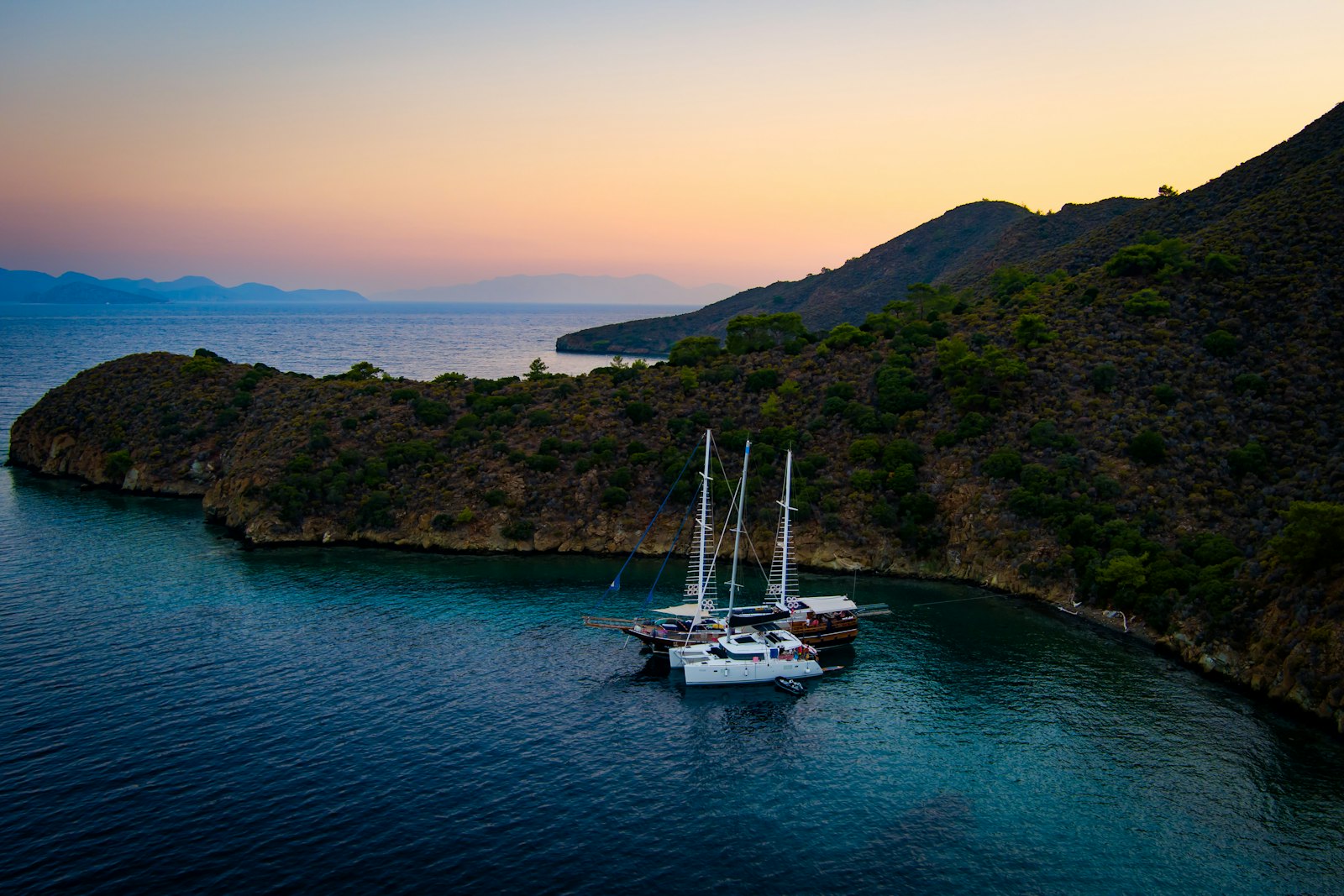
Once a group passes about eight people the shortlist narrows to two boats, and they are nothing like each other. One is a modern multihull that sails. The other is a wide wooden motorsailer with a crew and a cook. They cost similar money and deliver completely different weeks.
People usually decide on a photograph. It is worth deciding on four practical differences instead.
Cabins, and the privacy arithmetic
This is where the comparison is won and lost for a group of couples.
A gulet of 24 metres and up typically has six similar double cabins, each with its own bathroom, and that similarity is the point. Nobody got the owner’s suite and nobody got the bunk by the engine. For six couples travelling together, equal cabins prevent the conversation about who paid what for which room — and that conversation is the single most common source of friction on a large charter.
A charter catamaran is usually described as comfortable for eight, and the honest version of that is four double cabins with two people each. Twelve on a standard catamaran means putting people in saloon convertibles or skipper cabins, which works for a young group and does not work for six couples. Larger crewed catamarans in the 52 to 55 foot range genuinely do sleep twelve, sometimes with six doubles plus singles, but they are a smaller and more expensive part of the fleet.
One detail to check on either: whether the bathrooms have separate shower cubicles or whether you shower over the toilet. On a week with twelve people that distinction matters more than almost anything in the brochure.
Deck space, which is where the week happens
With twelve aboard, the deck is the living room. Interior volume matters far less than how many people can be outside, comfortably, at the same time.
A gulet is built entirely around this. A large aft deck with a long table that seats everyone for dinner, cushioned sunbathing for the whole group, and a separate forward lounging area so people can get away from each other. The beam is generous and the layout assumes a party of twelve rather than accommodating one.
A catamaran has a wide bridgedeck, a cockpit on one level with the saloon, and trampolines forward. Excellent for eight. With twelve it is adequate rather than generous, and there are fewer places to be alone.
If the holiday is mostly anchored, swimming and eating aboard, the gulet is the better platform and it is not close.
How each one moves
Here the catamaran wins decisively, and whether you care depends on what the week is for.
A gulet is a motorsailer in practice. The sails come out when conditions and the photographs suit; the engine does the work. Cruising speed is around eight knots and the boat is built for comfort rather than pace. You will not have a sailing holiday on a gulet, and crews who booked one expecting to sail are the ones who come back disappointed. What a gulet charter actually is covers that honestly, and the motorsailer type explains the design.
A catamaran sails properly, reaches higher speeds under sail alone, and has a shallow draft that opens anchorages a gulet’s size and depth close off. If somebody in the group wants to steer, trim a sail and feel that they went somewhere, this is the only one of the two that delivers it.
On motion, the sources argue and both have a case. A catamaran stays level — a few degrees of heel rather than twenty — which is why it is the standard recommendation for anyone prone to seasickness. A gulet is heavy, slow and engine-driven, which produces its own kind of steadiness, and gulet operators argue it suits children and older passengers better. In practice both are far more comfortable than a monohull, and the deciding factor is usually the shelter: a gulet’s enclosed aft deck is a better place to be in a chop than a catamaran’s open cockpit.
Crew, food and what is included
A gulet comes with a crew. That is not an option, it is the product — a captain, a deckhand and a cook, with meals prepared aboard. A standard charter typically covers the crew, fuel for a normal itinerary and harbour fees, with food and drink handled as a separate provisioning budget that you agree in advance.
A catamaran can be bareboat, skippered or fully crewed. Bareboat means somebody in the group is cooking for twelve, which is a real job and tends to fall on the same person every day. Skippered adds the person driving but not the person cooking. Fully crewed brings it level with the gulet and the price moves accordingly, with running costs handled through an advance allowance — see the APA explained and the three formats compared.
For a group of twelve, the catering question is bigger than it looks. Three meals a day for twelve people, from a galley, with shopping in villages, is most of somebody’s holiday.
The money, compared properly
Both are chartered as a whole boat by the week, so the cost per head falls as the group grows — which is the main reason twelve people can afford either.
A crewed catamaran of around 52 feet sleeping twelve runs in the region of €8,000 a week in low season and €18,000 in peak, plus VAT, which is roughly €750 to €1,700 per person for the week. Private gulets are quoted the same way and generally come out at or below that for equivalent space and service, with crew included — which is the comparison gulet brokers make, and on space-per-euro they are right.
Two costs people forget. Gulets are large and pay accordingly in harbour, and catamarans carry a berth surcharge of 50 to 100 per cent for their width — both covered in mooring fees. And the tourist tax is per person, so twelve aboard for two weeks is a real line rather than a rounding error, as set out in the local charges.
Compare the two by asking for the same dates and then listing: cabin count and whether they are equal, shower type, whether food is in or out, whether fuel and harbour fees are in, and whether VAT is extra. How charter prices are built explains why two quotes are rarely on the same basis.
Where each one lives
Availability may decide this before preference does.
Gulets are concentrated in Turkey, which is their home, with a reasonable supply along the Greek coast and a smaller number in Croatia, where cabin-share pricing also exists in the region of €700 to €1,400 per person per week with food.
Catamarans are everywhere — Croatia, Greece, Italy, Spain — but the twelve-berth crewed ones are a narrow slice of that and go early.
What else a group of twelve could take
These two dominate the shortlist, but three other types occasionally beat both.
A large motoryacht gives the most interior comfort and the fastest passages, with air conditioning that runs all night at anchor. It costs considerably more to run — the fuel case is in how fuel is charged — and it suits groups whose priority is comfort over being outdoors. Where that line falls is worth knowing before you ask for quotes.
A classic wooden boat is the gulet’s smaller, older cousin, chosen when the vessel itself is part of the occasion — a birthday, an anniversary, a wedding. Occasions aboard covers what that involves.
And a large cruiser monohull of 50 feet and up sleeps ten to twelve at a lower rate than either, with the caveat that it heels and the deck space is a fraction of a gulet’s. For a group who genuinely want to sail and will accept close quarters, it is the cheapest real sailing option at this size — see the route through the types and chartering with a family if the twelve include children.
The straight recommendation
Take the gulet if the group is six couples, if the week is about swimming, eating and being on deck, if you want crew and meals included without thinking about it, and if nobody needs to sail. Also if the group includes people who would find a modern charter boat cramped — which, at twelve, most would.
Take the catamaran if the group is twelve friends rather than six couples, if somebody wants to sail, if you want the shallow bays and the speed to move further each day, or if anyone’s comfort depends on a level deck.
And one honest alternative: two smaller boats. Two sailing yachts of six berths each, sailing together, costs less than one twelve-berth boat, gives everybody a proper cabin, and splits a group that may not want to spend fourteen consecutive meals together. It is more logistics and it is frequently the better holiday — see how flotilla sailing works. The realistic headcount for any one boat is lower than its brochure number, and with twelve people that gap is where holidays go wrong.