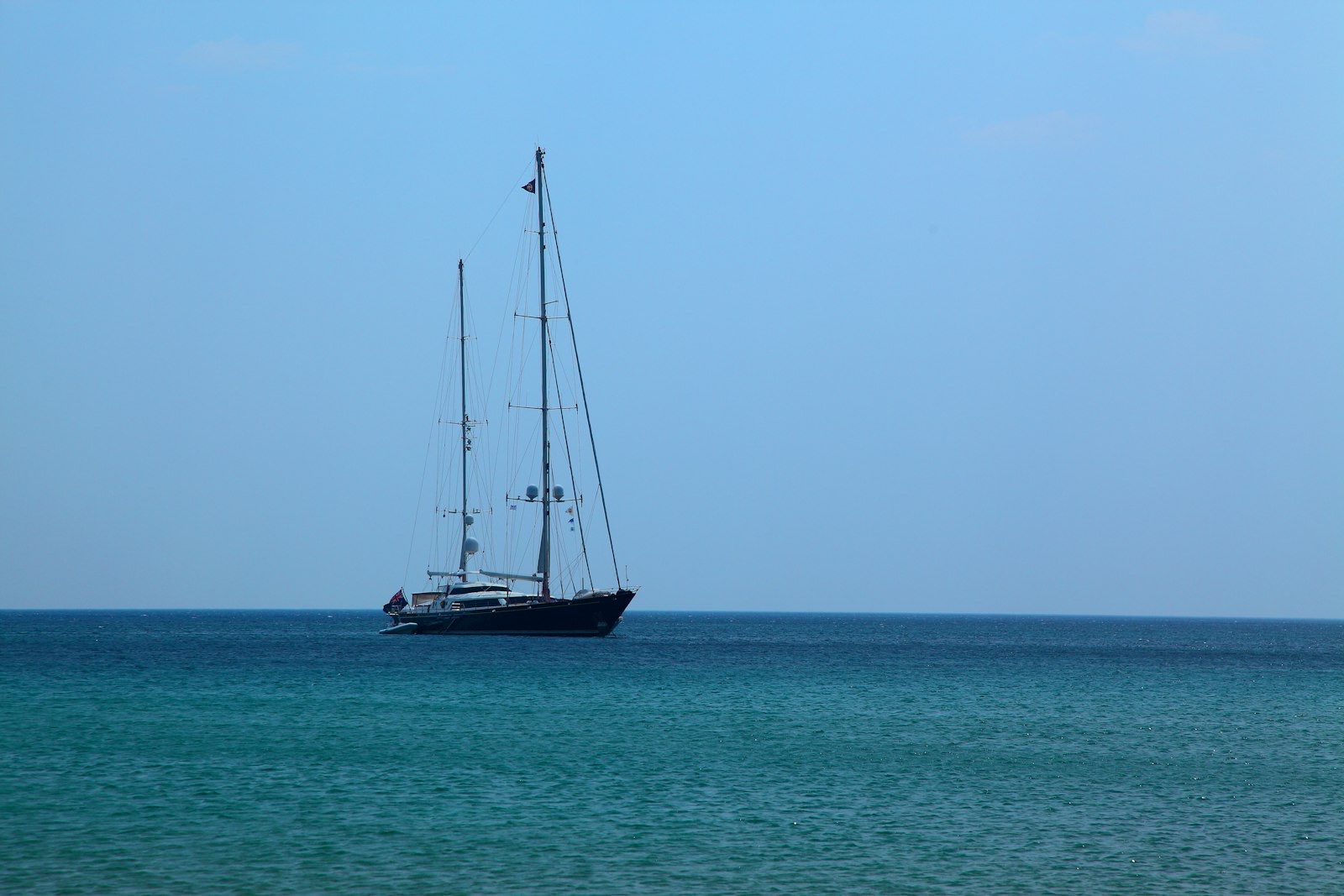
Boarding at one base and leaving the boat at another turns an out-and-back week into a genuine journey, with no day repeated. It is the best way to sail an island chain, and it carries a fee that people routinely discover late.
The fee is not a penalty. It pays for somebody to bring the boat home.
What you are paying for
The boat has to be back at its base for the next charter, and nobody is renting it on the way. So the operator pays for a skipper to travel overland to your drop-off point, their accommodation, and the fuel to motor the boat back — usually under engine, because a delivery is about hours rather than sailing. On top of that, the boat earns nothing during the return leg.
Seen that way the charge is straightforward arithmetic, and it scales with distance rather than with the boat.
What it costs
Expect anywhere from a few hundred euros to a few thousand depending on how far the boat has to come back.
Common short hops in Croatia and Greece are often quoted at €500 and up. A long repositioning can reach €2,500. One Greek operator’s published list — dated, but useful for the shape — showed roughly €400 from Athens to Lavrion, €700 to the Cyclades or Sporades, €1,100 to the Dodecanese and €1,200 to the Ionian, with around €500 for moves within a single island group.
The pattern is consistent: distance decides it, and a move within a group costs a fraction of a move between groups. Ask for the figure in writing before you book, and ask specifically whether it includes the skipper, their travel, the fuel and any mooring at the drop-off port — some operators itemise, others bundle.
One further point from the Croatian operators: on some routes the one-way fee and a skipper service are both mandatory rather than optional, which changes the total materially. The rest of the cost structure is in how charter prices are built and what the price includes.
The two costs nobody mentions
You may lose a day. Some operators require the boat to be handed back a day earlier than a normal charter so it can be delivered and prepared for the next week. A seven-day booking becomes six days of sailing. Check this explicitly, because it is a bigger practical cost than the fee on a short charter.
Check-out happens away from home. Your deposit — cash or a pre-authorised card slip — sits at the base you left from, and the damage assessment is done by somebody who did not hand the boat over. That can be rushed, and disputes are harder to resolve at a distance. Photograph everything at both ends, and read how the deposit works before you go.
Where it is genuinely worth it
Some cruising grounds are linear rather than circular, and in those the fee buys a much better week.
The Dodecanese are the clearest case: Kos down to Rhodes, or the reverse, taking in Kalymnos, Nisyros, Tilos and Symi with nothing sailed twice. An out-and-back from either end repeats half the route. The group from Kos and Rhodes as a base cover both ends.
The Ionian works north to south — Corfu to Lefkada or Preveza — which opens up Paxos, Antipaxos and Parga at one end and Ithaca and Kefalonia at the other, which no single base reaches comfortably in a week. See Corfu and Lefkada.
The Croatian coast rewards a run from north to south: Zadar or Biograd down through the Kornati and the Split islands to Dubrovnik. It is three hundred-odd miles of varied coast rather than a loop around one archipelago.
And the Aegean generally, where a downwind run with the meltemi behind you is a pleasure and the same route upwind is work — see how that wind behaves.
How to avoid paying it
Sail a loop. A circular route back to the start port avoids the fee entirely, and in compact island groups — the Saronic, the northern Dalmatian channels, the Kvarner — a loop sees everything anyway. In those places a one-way charter is paying for nothing.
Look for repositioning deals. Operators sometimes need a boat moved and will discount the week heavily to have you do it. There is no fee in that case, because you are doing them the favour. These are rare, they appear at the ends of the season, and you have to fit their dates and their direction — which puts them alongside late availability as a flexible-traveller’s option.
Use a multi-base operator. A company with its own boats at both ends can move the boat as part of its normal fleet rotation, and the fee is frequently lower or absent. This is worth asking directly: “do you have boats at both of these bases?”
Choose the shorter hop. A move within one island group costs a fraction of a move between groups, and often gets you most of the benefit — Kos to Rhodes rather than Athens to the Dodecanese.
Boat type changes the arithmetic
The delivery back is under engine, which means the fee tracks the boat’s fuel consumption as much as the distance.
A sailing yacht motoring home at five litres an hour is cheap to reposition, which is why one-way fees on monohulls are at the lower end of the range. A catamaran with two engines roughly doubles that, and operators price accordingly.
A motor boat or motoryacht is the expensive case: a delivery leg at cruising speed can burn hundreds of litres an hour, and the fee reflects it. On powered boats a one-way charter is sometimes quoted at a figure that makes a loop obviously better value — the fuel background is in how fuel is charged.
A motorsailer sits in between and is genuinely well suited to a linear route, because a long one-way passage is exactly where a sheltered helm and a capable engine earn their keep — see what that type is.
On crewed boats the question changes shape entirely: the delivery is the crew’s problem and the cost appears as a delivery fee on the invoice, which on larger yachts can run to several thousand and is set out alongside the rest in the APA explained.
Planning a linear week properly
A one-way route removes the safety margin that a loop has, and that is worth planning around rather than discovering.
On an out-and-back you can turn round at any point and still finish on time. On a one-way you have a fixed distance to cover by Saturday, which means a day lost to weather has to come out of somewhere. The fix is to plan the route at about two-thirds of the distance you could cover, leaving one spare day built in.
Put the longest legs early, while everyone is fresh and the schedule has slack. Leave the last day short, because arriving at an unfamiliar drop-off base late in the afternoon with a handover in the morning is how a good week ends badly — see what changes after dark.
And confirm the drop-off base’s check-out time and procedure before you leave. It is a base you have never seen, run by people who did not hand you the boat, and ten minutes of clarity beforehand is worth a great deal. The handover standards are in the check-in checklist.
Practical points before you book
Get the fee in writing with its inclusions. Confirm whether you lose a day. Confirm where the deposit is held and who inspects the boat. Confirm the drop-off port’s mooring is covered or not — it frequently is not, and the night before disembarkation is an expensive berth, as in mooring fees.
Then check your flights. A one-way charter means flying into one airport and out of another, which is sometimes cheaper than a return and sometimes much worse. Doing the flights before committing to the route is the right order.
And confirm the boat is permitted to make the passage at all — cross-border routes are frequently excluded, which is covered in the contract lines worth reading twice and the paperwork. If the route is long, the type matters too: a cruiser or a performance boat behave differently over three hundred miles, and the route through the options is the earlier decision. Fleets at Croatia, Greece and the wider Mediterranean.