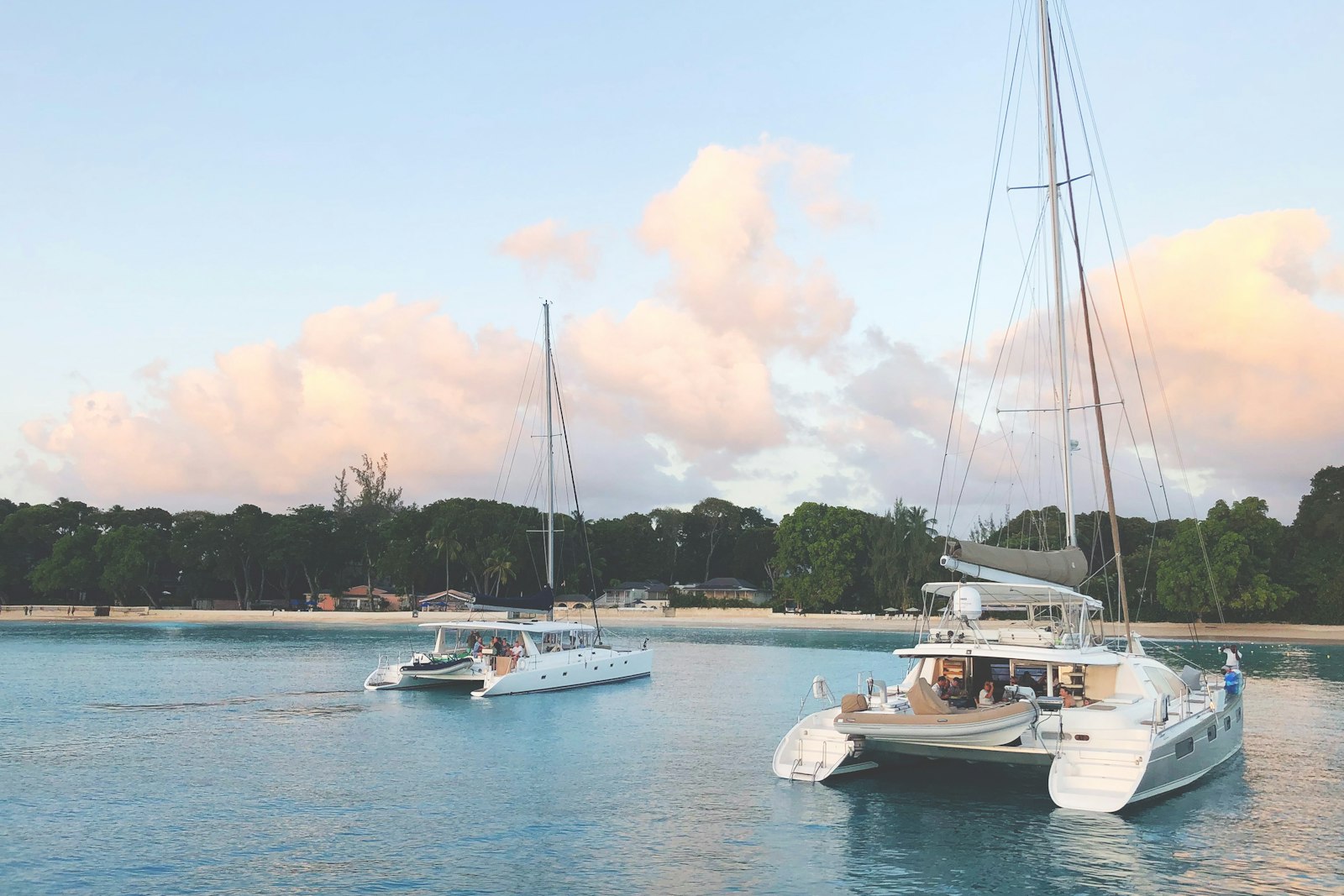
Fountaine Pajot is the other French catamaran yard, and the one sailors tend to prefer. Where Lagoon optimises for volume, Fountaine Pajot leans a little towards performance — narrower hulls, more sail area for the displacement, and a boat that will still be moving when the alternative has put the engine on.
The model names are islands rather than numbers, which is charming and unhelpful, so here is what each one actually is.
The names, decoded
Every sailing model is named after an island, with the length appended. So Lucia 40, Astréa 42, Elba 45, Saona 47. The number is the useful part; the name tells you the generation, because the yard replaces a model with a differently named one of similar size rather than adding a decimal.
That is the trap. A Lucia 40 from 2016 and an Isla 40 from 2020 are the same size and different boats, and a listing that says “40 foot Fountaine Pajot” has told you almost nothing. Check which island.
The sailing range currently centres on the Astréa, Elba, Aura, Samana and Alegria families, spanning roughly eleven to twenty-four metres. There is a separate MY power-catamaran line, which is a different product entirely — see where the powered boats sit.
The 40-footers: Lucia and Isla
These are the compact end of the range and the cheapest route into the brand. The Lucia 40, from 2016, and the Isla 40, from 2020, are both described as compact cruising cats suited to a smaller family or two couples who care about sailing performance.
That last phrase is the point. At this size a catamaran is a compromise — you have multihull stability and shallow draft, but not the deck space of a 45-footer. What you get instead is a boat that actually sails, and a rate that undercuts the larger models substantially. Weekly figures for a Lucia 40 run in the region of €4,200 to €6,700 depending on season and place, from broker listings that move with the year.
For two couples who want a catamaran rather than a monohull without paying for cabins they will not fill, this is the sensible choice. Four couples on a 40-footer is possible and tight — the realistic headcount is lower than the brochure’s.
The Astréa 42: the charter sweet spot
If you book one Fountaine Pajot, it will probably be this. The 42 is described as a very popular size for three or four couples, with a comfortable cockpit and a bright saloon, and it is the model most charter fleets stock in depth.
Two extra feet over the 40 buys a disproportionate amount: a genuinely usable cockpit table, a saloon that works when it rains, and cabins that two adults can both stand up in. It is the size at which a catamaran stops feeling like a compromise.
It is also the direct competitor to the Lagoon 42, and the choice between them is the brand choice in miniature: the Lagoon has more volume and a higher freeboard, the Astréa sails better and feels lower and closer to the water. Neither is wrong. The Lagoon range covers the other side.
The Elba 45 and Saona 47
The Elba 45, from 2020, is the modern mid-large model — spacious with good performance, which is the yard’s whole pitch expressed in one boat. Weekly rates in Greece have been listed anywhere from €5,500 to €13,300 across seasons, which is the widest band in the range and a reminder that the date matters more than the model. How season bands work explains that spread.
The Saona 47, from 2017, and the newer Tanna 47 from 2022 sit between the 45 and the big boats. At this size the boat sleeps ten to twelve properly and starts to want a crew to run it well — and the berth surcharge in mooring fees becomes a serious line, because a 47-foot catamaran occupies the width of two monohulls.
The large models
Above that sit the Saba 50, the Samana 59, the Ipanema 58, the Alegria 67 and the older Sanya 57 and Victoria 67. These are crewed boats in charter service, and the economics change completely: the running costs come out of an advance allowance rather than your pocket week by week, as set out in the APA explained, with a gratuity on top — see the convention.
For a group of ten or twelve, this is one of the two serious options alongside a gulet, and the comparison between them rarely resolves the way people expect.
Why the names change, and what it costs you
The island-naming system has a commercial logic worth knowing, because it affects what you can book.
Numbered models — a Lagoon 42, a Bavaria 46 — stay in production for years and accumulate a large used and charter fleet under one name. Fountaine Pajot replaces rather than revises: the Lucia 40 gives way to the Isla 40, the Saona 47 to the Tanna 47, and the older name simply stops.
For a charterer that has two effects. The fleets are younger on average, because the models turn over faster. And searching is harder, because you cannot look for “the 45” and get a decade of boats — you have to know that Elba is the current 45 and what preceded it.
The practical workaround is to search by length and let the names fall out, then check the year. That is the approach throughout the Croatian catamaran fleet and the Greek one, where several generations sit side by side at the same length and very different prices.
Sailing one, in practice
What the performance bias actually feels like on a charter week, as distinct from what the brochure says.
In eight to twelve knots of breeze the boat keeps moving where a heavier catamaran would be motoring. On a Mediterranean morning that is the difference between sailing out of the bay and starting the engine, and over a week it is several hours of quiet and a smaller fuel bill — see how fuel is charged.
Upwind it points better than the volume-oriented alternatives, which matters on the routes where the prevailing wind is against you — the northwest legs in the Dodecanese, or a day beating up the coast from Istria.
What you give up is freeboard and therefore interior height and locker volume, and a slightly less commanding view from the saloon. Neither matters much; both are what people notice when they step from one brand to the other at a boat show and then over-weight in the decision.
Fountaine Pajot against the alternatives
Against Lagoon: better under sail, less interior volume for the length, lower freeboard. If somebody aboard wants to sail rather than motor, this is the brand to look for. If the priority is maximum space per euro, the other one.
Against Nautitech: Nautitech goes further towards performance again, often with twin aft helms instead of a flybridge, which puts the helmsman in the cockpit with everyone. Worth looking for if the sailing matters most.
Against Leopard: Leopard is built for the same charter market with a forward cockpit as its signature feature — a second outdoor space ahead of the saloon, which is genuinely useful in a crowded anchorage and divides opinion otherwise.
And against a monohull at all: the honest comparison is in what a catamaran costs, because the gap against a Bavaria or Jeanneau of similar length is wider than the charter rate alone suggests once berths and fuel are counted — see the monohull builders compared.
What to check before booking one
Which island, and which year. Lucia or Isla, Saona or Tanna. This is the single most important line in the listing.
Cabin count and head layout. Three cabins or four, and whether showers are separate cubicles.
Helm arrangement. Flybridge, raised post or twin aft helms — it decides whether the person steering is part of the group all week.
Generator, and solar if fitted. Determines whether the air conditioning runs at anchor, which determines how many marina nights you need.
Bridgedeck clearance and draft. Clearance decides whether waves slap the underside; draft decides which bays you can enter. The multihull comparison covers both.
The handover list is in the check-in checklist. Fleets carrying these boats are across Croatia, Greece, Italy, Spain and Turkey, and if the type itself is unsettled, the route through all eleven options comes first.