Rhodes is the only Greek charter base where the town is a medieval walled city. You start a sailing holiday inside a fortress built by the Knights of St John, which is a better first evening than most bases manage, and the Dodecanese open northwards from the harbour mouth.
It is also the base with the most awkward berthing in Greece, and that is worth knowing before you arrive.
Mandraki, and its one real problem
Mandraki is the historic harbour at the northern tip of the island, immediately below the old town and close to the airport — which is why charter operators are based here.
It is a working harbour rather than a modern marina. Sources give it around a hundred and seventy berths, and the sanitary facilities are basic: in one assessment, a simple container that struggles with weekend crowds. Do not expect a pool.
The real issue is availability. Berths are extremely limited, particularly at weekends, and boats routinely moor two or three rows out. Visiting mid-week improves your chances considerably, and sailors wanting a guaranteed berth are commonly advised to go through a local agency that can arrange a mooring without advance payment.
For a charter crew this matters mostly at the end of the week: returning on a Friday or Saturday into a full harbour is the one genuinely stressful part of a Rhodes charter. Ask the operator exactly where you are to leave the boat and what happens if the row is full.
Rhodes Marina, in the northeastern part of the island, is the modern alternative with a full range of services, and Kolona Marina to the west of the town is the quieter option. If your boat is at either, the week starts more easily.
Where you go
Rhodes sits at the southern end of the Dodecanese, which means the sailing runs essentially one way: north and west up the chain.
Symi is the first and best stop, about four hours out. Gialos is a horseshoe harbour ringed with tiers of neoclassical mansions in ochre and terracotta — the most striking harbour in the group and deservedly busy. Panormitis monastery, at the island’s southern end, is the usual second night and a complete contrast.
Chalki is small, quiet and close, a good first night if you boarded late.
Tilos follows, almost untouristed, with Livadia as the harbour.
Nisyros is the one people remember: a live volcano where you anchor at Palon, go up by taxi and walk down into the caldera on warm ground that smells of sulphur.
Kos is the northern limit of a comfortable week and the obvious turning point — or, better, the finish. A sample itinerary runs Mandraki to Chalki and Tilos, then Kos, with longer versions pushing on towards the Cyclades.
The best route in the group is one-way from Kos down to Rhodes, or Rhodes up to Kos: Symi, Tilos, Nisyros, Kalymnos, each new rather than repeated. It costs a drop-off fee and it is worth it — see how one-way charters work and the group from the Kos end.
Wind, and why the direction of travel matters
The main season runs May to September with warm weather and, in the shoulder months, genuinely gentle conditions.
In high summer the meltemi arrives, blowing from the north through the channels at up to thirty knots. That has a specific consequence here that it does not have at other bases: because the cruising ground is north of you, the outbound leg is upwind and the return is a run. A week from Rhodes in August means working out and sailing home fast, which suits some crews and not others.
It also means the harbours on the northern sides of islands become uncomfortable, and a day in port waiting is a normal part of August rather than a failure. How the meltemi behaves is the piece to read before committing, and crews without open-water experience should take somebody who knows the channels.
From mid-September the wind eases markedly. Late September and October here are excellent — the Dodecanese sit far enough south to hold their season longer than the Cyclades, with warm water and empty harbours. The case is in sailing in October and November.
The old town, and the extra day
Worth planning for. The medieval city is the largest inhabited walled town in Europe, built by the Knights Hospitaller in the fourteenth century: the Street of the Knights runs intact from the gate to the Palace of the Grand Master, and the walls themselves are walkable.
Below that is a Turkish and Jewish quarter from the later Ottoman centuries, and outside the walls a 1930s Italian administrative town — Rhodes was Italian until the Second World War, which explains the architecture people find hard to place.
Practically: stay inside the walls for the night before boarding, not near the marina. The restaurants on the main tourist lanes are poor and the ones two streets back are not.
Turkey, and the usual answer
Marmaris and the Turkish coast are close, and the question comes up every week. Crossing is a formal exit from and re-entry to the European Union with clearance at both ends, and the great majority of charter boats are not permitted to leave Greek waters.
It must be arranged with the operator before booking. If the Turkish coast is the point, charter from Turkey instead — the fleet is deep, the gulet tradition is based there, and chartering in Turkey covers it. The formalities are in the charges and documents.
Which boat
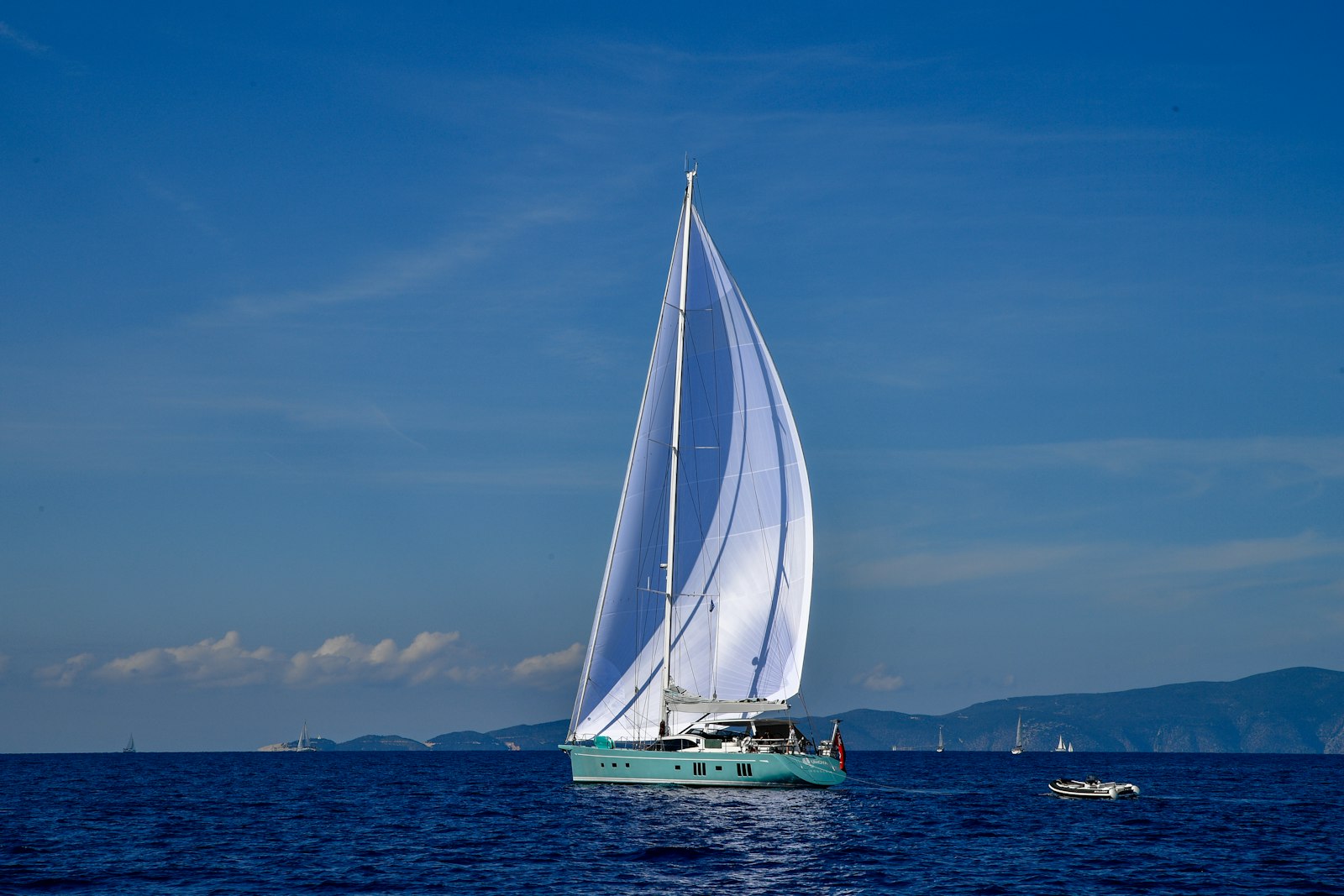
A sailing yacht from Rhodes in the low to mid forties is the standard booking and the right size — enough waterline to work upwind in a breeze, small enough for the crowded quays. Listings from Mandraki include both bareboat and skippered; a mid-forties monohull with a skipper runs in the region of €600 a day in season, which tracks the rest of the Greek market set out in what a Greek week costs.
A catamaran from Rhodes is the right call if anyone aboard struggles with motion, because a level deck in meltemi chop is worth a great deal — see multihulls, what one costs and the motion question. The trade is handling: a catamaran’s windage in thirty knots, in a harbour where you may be mooring in the third row, is a real consideration.
A motoryacht removes the wind from the planning at the fuel cost described in the fuel policy, and where that line falls covers what you get. Berth pricing in the Greek harbours is in mooring fees, and if the type is unsettled, the route through the options comes first.
Rhodes or elsewhere
Choose Rhodes if the city is part of the trip, if your flights land here, and if you want Symi and Nisyros early in the week rather than at the far end of it.
Choose Kos if you want the Dodecanese from the middle with both directions available, better provisioning and easier berthing. Choose Lavrion for the Cyclades instead, and Lefkada or Corfu if you want light wind and shelter rather than a sailing challenge.
Across the Greek islands, Rhodes is the base with the best town and the hardest harbour. Which Greek islands to pick compares the regions, and the Athens marinas the alternative starting points.